Wowio
Several months back, the webcomics community took notice of Wowio, a site that gives access to free eBooks.
Most of that notice, unfortunately, was negative – some misreadings of the company’s policies led many to believe that they shared user’s personal data with outside corporations, a practice that, unsurprisingly, most folks would not be ok with. Given the nature of the information required to start an account – credit card data, a scan of personal ID such as a driver’s license, or a non-anonymous e-mail address – a lot of folks dismissed it as something of a scam, and turned their backs on it.
Three and a half months later, I think that is a damn shame.
Once it was made clear how the company’s policy actually worked, I got right on board. Over the next week, I downloaded the few eBooks I was actually interested in reading (less than a dozen), and then I stopped using it to acquire reading material. Instead, I started using it to support webcomics with money that was, essentially, free.
For each person who downloads an issue of a comic on Wowio, the creator gets 50 cents. That’s the reason they have such a relatively strict sign-up process – so they can make sure each new account is unique, since there really aren’t that many ways to do so over the internet.
You can only download three books a day. And I suppose a dollar and a half doesn’t seem like the hugest contribution to put in your favorite creator’s pocket. But on the other hand… it costs you two minutes to do so, and you can do it every single day. Sure, you are limited by how many different webcomic downloads are available on the site – but I just took a quick look through, and saw around 166 just from titles I recognized. $83 dollars is looking a bit more solid – even spread out between a dozen creators. Especially considering every single reader can be making the same contribution.
And in the months it takes to make those downloads, who knows how many more titles or issues will be added to the site?
I’m not holding this out there as something people have to do, not by any means. But it strikes me that Wowio got a pretty bad rap when it first hit the scene, and deserves to be recognized for the opportunity it is: a chance for people to easily give some money back to creators without spending any out of their own pockets.
I mean, let’s face it – if every webcomic made a dollar off of every single reader they had, there would be hundreds more webcomics making enough to support their creators, as opposed to the several dozen there are now. Unfortunately, getting that dollar is not only a challenge, but an impossibility, for any number of reasons. Even for those who are really devoted to the comics and want to give back, it can be hard – I read hundreds of webcomics, and if I tried to support every single one, it gets costly.
So most people tend to support one or two of their favorites. And the comics that succeed are often ok with this – they count on getting money (via merchandise, donations or otherwise) from only 10% of their readership, or maybe even less. There is nothing wrong with not being able to give that dollar out.
But for those who really want to do so anyway, but just don’t have the money, or the ability to choose which webcomic out there deserves it the most… well, therein lies the beauty of Wowio.
It takes maybe ten, twenty minutes to set up an account. All signs indicate the process of doing so is, actually, safe and secure. Once you’ve done so, another two minutes a day to download eBooks and give back a dollar fifty to some deserving creators. While you’re at it, you can enjoy the product itself! Or you can just toss it out, if all you were looking for is the chance to give back.
I’ve been keeping at it. I’ve been doing it with comics I’ve stopped reading – for all my criticism of the works of Chris Crosby a few months back, I’ve probably downloaded twenty-plus of his strip’s issue since then.
I’m going to go back to the premise one last time – this is a way for readers to contribute money to the webcomics they read for free. Ok, I get that it seems to good to be true, but it seems to work. You download eBooks, Wowio gets paid by advertisers who like being able to put their ads in each book, and some of that cash goes to the creators that deserve it.
How is that not a win-win situation for every single person involved?
The Whole is Greater
 Everytime I realize that the comic that has me the most on the edge of my seat is Starslip Crisis, I feel a moment of confusion. I shouldn’t, of course, given that I’ve been in this situation before… yet it is oh-so-easy to slip into thinking of the comic as just another silly strip with a daily punchline and lovable cast of characters.
The premise revolves around a pretentious curator sailing a traveling art gallery through space, accompanied by an ex-pirate and an alien with paralyzing saliva and a certain lack of understanding of human nature. Along the way they meet crazy artists, tyrannical despots, homicidal robots, benevolent monarchs – it’s your standard set of zany adventures, and Straub has a very good sense of where to land the punchline and unleash the laughs.
Yet somehow he is also able to take those characters and weave a compelling and intense story out of it. To pit these joke characters against epic adverseries and yet have them manage to triumph. He makes it work, and even more amazingly so, he manages to make the transition from one to the other seem entirely natural and, in fact, almost inevitable. The comic never takes itself too seriously, and yet it still manages to forge a connection with the reader and leave them genuinely affected by the plot.
Currently a war is being waged by Lord Katarakis, an insane space tyrant out to conquer… well, pretty much everything. He has control of a specific piece of art that, when viewed in a certain context, renders those viewing it essentially mind-controlled.
The fleet opposing him – of which Memnon, protagonist and curator, has found his ship recruited into – is tricked into viewing a massive projection of the art, thus removing all resistance to Katarakis’s plans.
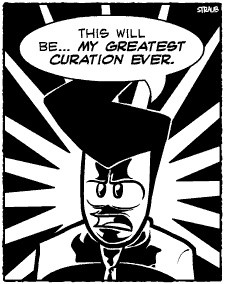 Except that Memnon realizes that viewing a projection of the art is seperate from viewing it directly, and this changes the context and snaps him out of the control. Because of his pretension, because of his devotion to art, because of his very nature that has been the punchline of the strip since day one… because of all that, he is the only man able to stand against Katarakis. Storylines that have been building up in the strip for years have come to this one moment in which he will have a chance to prove himself, a situation that he and he alone could make possible.
From the beginning it was obvious that Kris Straub had a command of humor, and could ensure the strip was fun day in and day out. And it was not long before I became impressed with the depth he could imbue in the shallowest of characters. And I even slowly came to realize that he could produce some dramatically powerful storylines.
But I think this is the moment were I am really able to see the grand tapestry – to see that the story being told, for all its disparate elements, could not be told without every last one of them. Before, I have enjoyed all the individual pieces of the puzzle – now I am able to see them brought together, and it is hard not to be impressed.
I’m not sure precisely how this storyline will end. Memnon may pull off something incredibly badass, or he might end up fumbling his chance and require Mr. Jinx to save the day. Maybe we’ll even see Zillion and Colonel Samuel Q. Breckenridge… or maybe not.
But regardless of what will happen, all I know is that was has happened has been awesome enough to leave me decidedly eager for more.
Farewells
Yesterday, Home on the Strange came to an end. Today, Bang Barstal also says goodbye… at least for now.
Eric Burns, of Websnark fame, does an unsurprisingly good job of discussing the end of HotS. It is certainly a shame to see it come to an end, and there is a sense that many more storylines could have been explored – but the comic wrapped things up as well as could be expected, which is more than many fallen webcomics can say. Fading away into memory and the land of the Great Hiatus is no proper way to go, and HotS concluded things in the same way it did everything else – with a mix of professionalism and good humor.
I am sad to see it go, and I do hope we are able to hear the end of Branch’s story – but there are many other webcomics in the same vein, and I don’t suspect I’ll feel its absence for long.
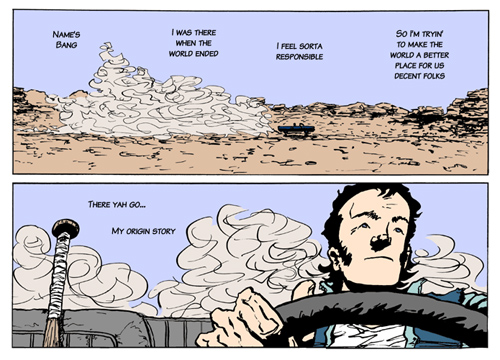 Bang Barstal, on the other hand, will be more thoroughly missed. I won’t claim this is due to some nebulous sense of superiority, though – they are both great comics in their own way. But Bang Barstal was relatively unique in the webcomic world, embarking upon storylines that stood alone, with a “hero” whose sense of style and purpose was both original and compelling. Even the art is visually distinct, something especially felt in the last few chapters of the strip. And the ending, as sad as I was to face it, managed to finish things on an absolutely perfect note.
It is also the creation of one the William G, internet critic and webcomic rabblerouser.
I should make something clear – a few years back, I don’t believe there was a single figure involved in webcomicdom that I had a lower opinion of than William G. This was following the height of his prominence, a time when, it seemed, he was at the height of his troublemaking and attacks on the fools who dared to enjoy popular webcomics.
But you know what? Hating folks for having unpopular opinions is boring. And I came to realize most of my problems with the fellow stemmed less from what he was saying, and more from how he said it. Oh, I still disagreed on any number of topics – but I didn’t regard his presence on the internets as a personal insult. Sometimes, sure, he was still a dick – but there were also times he had genuinely insightful things to say. My view of fandom (and its dangers) isn’t nearly as extreme as his – but I’ve also come to realize a lot of things about it that I wouldn’t have without his rants.
The thing of it is, though, that even when I very thoroughly disliked William G as a person, I was still a fan of his work. That was when he was doing It’s About Girls, which was a powerful and realistic personal drama strip at a time when the web was remarkably lacking in such comics. (It’s still around today, though I am not sure for how much longer, with script still provided by Mr. G, and art done by the talented Sahsha Andrade.)
Now, I’ve done this with other comics as well – I continue to read Ctrl+Alt+Del despite the many signs that Tim Buckley is not all that nice a guy. But I’ve always felt somewhat dirty doing so, at supporting someone who really didn’t deserve it.
I never felt that with It’s About Girls, or with Bang Barstal – because they were just that good. They were strong, solid, independant strips that stood out from the crowd. They were legitimately well done works of art, and they deserved every reader they got. I couldn’t feel ashamed of reading them; I think I would have only felt ashamed had I walked away simply because I didn’t like what the man had to say. And I always felt the biggest crime of all the drama surrounding William G was that it did drive away many others who would have otherwise enjoyed his comics.
Bang Barstal has come to a very satisfactory end… and also left some possible room open for a sequel, some time down the road. Will has sworn off webcomics several times before, and returned every time – and this time even he seems to expect that one day he’ll return to the drawing board.
And I have to say, regardless of all the drama and flames and silliness that has followed in his wake… if his next work is anywhere on par with what he did with Bang Barstal, I’m looking forward to it.
Rejecting the Status Quo
In the last year and a half there seems to have been a slew of webcomics focused less on wacky hijinks and more on tightknit relationship-based drama. Punch an’ Pie, Scene Language and Octopus Pie all come to mind – and interesting enough, they are also all webcomics launched by creators with previous works under their belts.
What I have found most interesting, however, is that they are also nothing like what I have become accustomed to. Most such webcomics usually rely heavily on the tension of unrequited love – you have several character clearly attracted to each other, clearly meant to end up together, but events conspire to prevent them from doing so for years at a time. Sure, it allows for an easy hook to keep stringing readers along, but it also seems like the easy way out – and after seeing the same plot time and time again, it quickly grows boring.
Which is why I am very impressed with all these recent webcomics that decide to go in entirely the opposite direction.
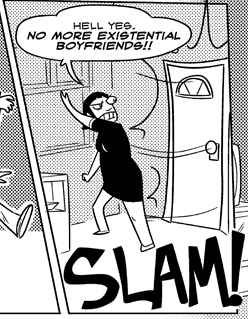 Octopus Pie took only a handful of strips to break up Eve with her boyfriend – but it did a good job of focusing her personality and setting the stage for the dynamics to come, and how she relates to her roommate and how she deals with her newest potential love interest. Relationships are a fundamental focus of the comic – and not just specifically those of an intimate nature, but all the connections between Eve and the world around her, with her family, her friends, her coworkers.
Scene Language, meanwhile, has involved even more turbulence – the first major arc involved one of the four main characters, Charlie, breaking up with her boyfriend, while two of the other main characters discover themselves in something resembling a relationship. The arc concludes with what seems to be the status quo the story has been building towards – the four protagonists rent a house together, and it seems likely they’ve found their respective places in the strip dynamics. The second storyarc dispels that notion, however, as relationships continue to shift, develop, and fall apart.
Punch an’ Pie, on the other hand, features a split I never saw coming. Oh, it wasn’t done in a haphazard fashion in the slightest – but it still came as a surprise. From the beginning we were told that the strip followed the life of Angela, whom many still fondly remembered from Queen of Wands. But despite Angela being the star, her girlfriend Heather seems an equally vital part of the strip from the start – and given the strip largely begins with their relationship moving to a new stage (as they move in together), it seems like something integral to the entire comic, and unassailably intact.
Until it’s… not.
These three strips are not the only ones to deal with this kind of plotlines, and they all approach it in different ways – some have gone through changes that cannot be undone, while others leave plenty of potential for reconciliation. Yet I find one thing undeniably clear – all of them, within their first year, are willing and almost eager to break the status quo. They are not content with leading readers along through the same stories and the same situations, with the hope for an eventual happy ending dangling at the end of the string, eternally just out of reach.
Instead, they shake things up. People change, relationships change, and – in the end – the world moves on. This isn’t just more realistic storyline, it is also infinitely more ambitious storytelling. I mean, look at how long these strips have been around, and look at how much has happened within them. Some comics can take years to cover the events of a single day, or week, or month, and even when all is said and done, nothing fundamental has actually changed. Which can still make for a fun story, sure – but how much less rewarding is that compared to seeing a character genuinely grow, or seeing life actually taking place before your eyes?
These comics may not be alone in the route they’ve taken, but I still feel as though we’ve seen a growing trend towards this brand of comic in the last few years. Maybe because the creators have dabbled (or more) in the field before, and have learned from those experiences. Maybe because, with the vast number of webcomics out there, it requires a stronger story to get the attention of an audience. Maybe because the authors and readers simply have more life experience to capture within their tales.
Whatever the reason, the trend seems to be there, and the arrival of stories of this caliber is a development I can certainly get behind.
Post #487, in which I review a webcomic.
By next week, I should be back in the groove of updating. NaNoWriMo shall have come to a close, and while I won’t be hitting the 50k mark, I’m relatively happy with what I did write, which seems a reasonable mark of success in my book. But anyway – next week, regular updates. For today, a review of Kukuburi.
I’ll be honest – I like Butternut Squash, I really do, but I’ve never really considered it in the top tier of webcomics… and if you had told me that one of the creators would suddenly start producing one of the most intensely imaginative webcomics around, I simply wouldn’t have believed you.
But he did, and it is Kukuburi.
 In the last year, I’ve noticed a substantial growth in the field of delightfully surreal fantasy comics – but this hasn’t diminished my enjoyment of them in the slightest. This strip, which begins with a lizard, seems eager to get to the moment where the magic begins to flow… but that doesn’t diminish the potency of the first ten pages.
I mean, I know Ramón Pérez is a fantastic artist – Butternut Squash made that plenty clear. But the writing in this piece holds up wonderfully, and the rising tension in those first ten pages really latches hold of the reader. The other most impressive factor is the attention to detail – or, more accurately, all the little touches that elevate this beyond just a simple fantasy romp.
The way obscenities are portrayed as small little skull icons within dialogue boxes, rendered not just harmless, but actively cute. The ability of characters and locations to be present for no more than one to two panels – likely to never be seen again – yet still remain interesting enough to catch the eye. The use of color to show us where this is going before we even get there. (The weight of the simplest of things – somewhat later on, I’m impressed by the appearance – and meaning – of a single flower.)
The fact that Pérez manages to follow our heroine’s life for those first ten pages without ever once truly showing us her face, until the moment she steps into the bizarre fantasy adventure awaiting her.
In some ways, I almost like that introduction more than what actually comes after it – but I suspect that is in part because the introduction is complete, while the story itself is only getting started.
Thus far, the plot is simple but potentially complex: Nadia lives a normal, everyday life, until today – wherein she steps into a fantastic world of color and flying whales and floating islands and many other wonders. We don’t yet know why she is here or the nature of the world, though it seems clear she is connected to it in some very important way.
It is a story, thus far, that we’ve seen before – in the works of Miyazaki and Neil Gaiman, in the classic of the Wizard of Oz.
The question is, for all the pretty artwork (and it is very, very pretty), can it stand on its own as something new and unique?
I have high hopes. Even aside from the art, there is a very strong sense of style amidst the absurdities, and that is important. But the real key, I think, lies in the star of the show – Nadia, the heroine of the tale. Because she really stands out as her own character – spunky, strong, and capable of coming out on top despite being in over her head. She’s not something we’ve seen before, and I think she is the key to the story being more than simply an exercise in beautifully illustrated imaginings.
For now, I’m willing to simply sit back and be amazed by the quality of the work and the somewhat frightening speed at which it has been released, considering it isn’t Pérez’s only webcomic.
I’m surprised it took me this long to discover it (especially considering I actually read his other comic), but I’ll attribute that to my usual inability to stay in the loop. I suspect, however, that this is a comic it won’t be so easy to hide from as word spreads – while it might be small now, it certainly has the potential to be one of webcomic’s rising stars.
It certainly qualifies, by my standards, as a damn good comic.
We could all use a little change
One of the most interesting things about Penny and Aggie is the fact that the two title characters don’t necessarily turn out as who you think they will be.
Penny represents the popular crowd – she is charismatic, manipulative, apparently shallow. Aggie, on the other hand, is the type most webcomic readers would be more likely to connect with – she is the outcast, the poet, focused on creativity and remaining true to her ideals.
Yet somehow… Penny has become the more interesting figure. Perhaps it is because there is more room for personal growth and development (though the path to true maturity is laid out for Aggie as well.) Perhaps it is because the need to explore such a seemingly different personality has resulted in a much stronger presence. Perhaps it was simply an attempt to break stereotype – and encourage readers to be patient before making judgements, one way or the other.
Regardless of why, it has meant that Penny has had a bit more screentime (or it at least feels that way) – and somehow she’s ended up as the actual star of the show. She has matured, though she largely remains the popular girl, the queen bee – but she genuinely cares about her few true friends, and her social awareness also demonstrates a pretty powerful core understanding of how people work.
In the current storyline, her ex-boyfriend (who she still loves), has just emerged from being hospitalized after a stabbing. Upon recovering, he reunites with Penny in a remarkably effective scene. Shortly thereafter, announces his plans to ride off and “live the American Dream” – and he invites her along.
And that is when things get good.
We abruptly launch into the sort of high-concept scene that T is so fond of: A convention of Penny’s future selves, assembled to vote on which future she should head towards. Some of them are harder to visualize Penny ending up as, but none of them seem impossible – and all of them have a distinct voice and design. T and Gisèle clearly had fun with them – and with the challenge of defining them in the span of only a few moments.
They talk about the future, and about the pivotal decision of whether to follow Rich or not. Both paths clearly have good and bad potential outcomes, and any manner of possibilities along the way. But the chances of actually making a life with Rich seem low, and they vote, and decide to let Rick ride alone by a landslide…
 And Penny – Penny as she is, not as she might be – shows up to have her say, and it is possibly the comic’s best moment yet.
“I am not a person-in-the-making, I am a person now.”
That’s a powerful line, and the speech that follows it is even more heartfelt. Penny is going to follow her heart, decide her fate based on the now, rather than the future, and leave with Rich, no matter how crazy it seems.
And here’s the thing – this is a terrible idea. I don’t think it will end will. I think that Rich is making a mistake by running off without a plan, and Penny is making a bigger mistake by pursuing him…
…but I’m rooting for them to succeed.
That’s the accomplishment here – that is the demonstration of the power of this scene. I know this will end poorly. I know this isn’t going to work out. But I can still tremendously admire Penny’s decision, and hope for it to turn out for the best. And in the end, even if things completely fall apart, it was her decision to make – and I suspect she will emerge the better for it, one way or another.
I am curious to see where it goes, certainly. I mean – title character, you know? Is the comic going to follow her new adventure? Let her fate go unknown into she rolls back into town a few months down the road, after things have gone south?
I’m really hoping the next page or two doesn’t pull some silliness to bring it all to a halt before it begins – stepping back from the decision to leave would not just be disappointing, but thoroughly undermine the power of the scene itself.
But… we’ll see what happens. And if Penny vanishes from the comic for a time, to discover whatever lies in wait? That just might mean a chance for Aggie to take center stage, and for us to learn what she is made of.
52 Things That Bother Me
I recall, when DC’s 52 wrapped up, that one of the complaints T Campbell had about it was how they had gone through the entire messy business of restarting the multiverse, allowing them a massive realm of new and interesting possibilities to explore, and decided to fill up a large portion of their new worlds with various older stories and elseworlds and etc.
I understand his point, though this didn’t really bother me personally – I hadn’t read most of those stories, so they were largely as exciting and new as the handful of worlds DC left open for any new stories they decided to tell. All in all, it seemed like a clever idea: 51 new universes for DC to play around with. To tell the stories they can’t tell with their core continuity. To tell new stories to attract new readers. To do all sorts of nifty things.
Which is why I have been so incredibly disappointed with the use to which they have been put thus far. The latest weekly series from DC, Countdown, involves some heroes from Earth-1 wandering from one alternate Earth to the next, where we briefly glimpse what is going on (occasionally throwing it into disarray) before they hop onto the next world.
Even better, heroes and villains from those worlds are being recruited into some grand galactic army! They have instantly gone from having the potential to tell their own, new and interesting, stories… to being bit players in the current DC Mega-Event. I mean, how is this not simply an enormous waste of resources and possibilities?
They’ve even got an upcoming event, Countdown: Arena, wherein multiple versions from various realities will be forced to duke it out to see which will have the honor of joining the galactic army. And, hey – I can understand the raw appeal of it all. We’ve all seen fans get into debates over this sort of nonsense, whether their favorite superhero could beat up their buddy’s favorite, and this is simply that on a grand scale.
But man… it just seems so short-sighted.
In this week’s Countdown, Superguy Prime (currently one of DC’s top villains) wandered into Earth-15, killed the Justice League, and then destroyed the entire planet.
What is the point of coming up with these alternate worlds with potentially new and interesting characters – or variations on characters – and then immediately throwing them by the wayside? Isn’t this their chance to start laying the ground for the future, start finding a way out of the rut the company has been stuck in for years?
On the other hand, the one thing print comics don’t seem to have the luxury of is planning ahead. Titles get passed from one writer to the next, plots get subsumed into whatever mega-crossover/event is currently going on, and anything undesired that came before gets retconned into oblivion.
There are many folks much better qualified than myself to comment on the state of the print comics industry, as well as the various stories being told by DC and Marvel. But I feel that I am justified in saying this, if nothing else: I think it is a downright shame that DC can come up with such a cool idea as the new multiverse, and within half-a-year, already have begun laying waste to that accomplishment.
Things That Bother Me: Sluggy Freelance
Second on the list of today’s rants: Sluggy Freelance.
There are a lot of people that want Sluggy to go back to how it use to be – though, personally, I think that exact goal is a large part of the comic’s current failings.
There are also those who are frustrated with how far we’ve regressed from That Which Redeems, both in regards to the epic scope of events, as well as to the apparent maturation of the characters that has vanished like dust in the wind.
There are even those who think things need to head towards a conclusion, a tidying up of storylines and loose ends, and a culmination of all that has come before, rather than allowing things to die with but a gradually fading sigh.
Right now, I’m not too worried about that. Right now, my one true request of the strip – the one thing I really, genuinely desire…
Is for the strip to stop actively trying to convince me the main characters are the most unsympathetic beings in the universe.
Let’s dial back the clock a few weeks, and take a look at strips, and the punchlines thereof, one-by-one.
Oct 29: Gwynn is an idiot, and shallow.
Oct 30: Gwynn is an idiot, and shallow, and bitchy.
Oct 31: Gwynn is an idiot, and shallow, and bitchy.
Nov 1: Gwynn is… oh, you know, see previous.
Nov 2: Zombies are idiots. Hey! Score one for the good guys.
Nov 3: Random filler.
Nov 4: Random filler.
Nov 5: Gwynn and Zoe are shallow, and bitchy. Oh yes, and idiots.
Nov 6: See above.
Nov 7: Gwynn is really an idiot.
Nov 8: Changing the pace up by dragging back out a joke that wasn’t funny the first time it was made.
Nov 9: A bunch of exposition, followed by characters momentarily acting like decent human beings… followed by Riff and Torg acting like shallow idiots.
Nov 10: Random filler.
Nov 11: Random filler.
Nov 12: Characters briefly sharing a touching moment… followed by Torg being a shallow idiot.
Nov 13: Riff is a jerk. Aylee is a plot device.
Nov 14: Gwynn is jealous, and it is fun to laugh at blind people.
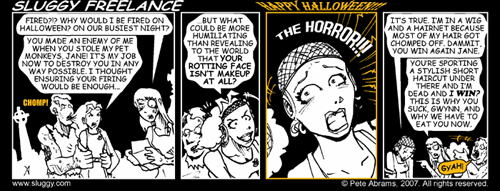 …look, I don’t ask for much. And I know that, in the end, the characters being idiots has been a time-honored tradition of Sluggy Freelance. I know that having characters with genuine human flaws goes a long way towards connecting with the audience, and has been one of the factors that has allowed the strip to go through some of its more powerful arcs.
But there needs to be something to sympathize with, too. And having day after day of being shown how wretched these people are… how much they fail as friends, as workers, as human beings… all it really does is push me away.
And, yes, it does sting worse because Torg has been through That Which Redeems, Zoe has been through Fire and Rain, Gwynn has been through The Bug, the Witch, and the Robot, Riff has had Dangerous Days – and I don’t think it is a coincedence that these are easily among the best Sluggy storylines, and also the ones that have featured genuine character growth.
Character growth that, unfortunately, gets thrown out the window as soon as it becomes convenient to do so.
I understand why. I mean, Pete Abrams makes a living off this strip. He was among the earliest webcomics to do so (if not the first), and the strip is a vital means of supporting his family. And the strip has, for ten years, been about a bunch of idiots who get involved in crazy adventures. And regardless of all the baggage they’ve accumulated, all the growth that they have undergone… he needs to preserve the strip the way it has been, all this time. Stick to the formula, to what he knows works, and it will continue to do what he needs it to do.
He got burned, heavily, with Oceans Unmoving… and I think he learned the wrong lesson from it. Don’t deviate, is what he heard, don’t experiment. But what people really wanted was to continue the story with the characters they liked before diving into something new and unknown.
I don’t think Sluggy Freelance needs to end. For a time, I did – but comics, just like characters, can grow without needed to come to an end. I think there are plenty more years of life left in the strip. I’d like to see some things resolved, yes, and I’d like to see characters that actually reflect the struggles they have been through…
…but right now, all I’m asking for is to be tossed a bone. I’m not even going to ask for Pete to make me like the characters again – just don’t make me dislike them! The punchline for every strip shouldn’t be how much they fail at being worthwhile human beings! That’s all I’m asking for – I don’t expect you to make them into geniuses or have them suddenly outgrow all their character flaws.
Just don’t rub my face in those flaws day after day, strip after strip, to the exclusion of all else. Temper the flaws with some understanding, balance the humor more evenly, overcome the need to break the characters down into one-note jokes.
I’ve always said that Sluggy, among all the comics out there, is the one I will always have faith in. This is a strip that has gone through dull stretches and come back strong. So I’m willing to keep reading, and keep waiting, and see where the strip is going to go… as long as you don’t make me hate the characters.
Because once I’ve lost all faith in them, and all the investment that has been built up with them after all these years… well, then there’s no more reason for me to keep reading, whether the story improves or not.
 Damn Good Comics