Good ol’ Durkon.
Hello! Again. It has been some time, hasn’t it? I can’t pretend to have any real reason for the lapse, other than the usual shifting sands of life – but I could say that those sands have, as it were, brought me back along the tides to my writing roots. I could say that, I suppose, if I wanted to really mangle some metaphors.
So why don’t I put metaphors and excuses aside, and offer up a humble apology, not so much for the absence itself, but for the abrupt and silent nature of its occurence… and move on to that which has inspired me to once more set word to website.
It involves another return, and one of far more note than my own – the return of the Order of the Stick, which has seen over a full week of non-stop comics after a long delay caused by genuine issues like mangled thumbs and tons of effort spent on an almost overwhelmingly successful Kickstarter.
But recovery seems to be going well for Rich Burlew, and we’ve gotten back to the action in a big way.
When we left off, the Order of the Stick were in the midst of an all out skirmish with their counterparts, the Linear Guild (with support from our new frighteningly capable villain, General Tarquin.) With the return, Roy got the chance to demonstrate his own skills as a leader, unleashing a stunning counterattack against the Linear Guild and their allies.
But the action, while among some of the most epic sequences yet in OotS (even if the gang isn’t quite epic as of yet) is only one of the reasons why so many fans have been so desperate for the comic’s return. The action might be one part of it, but right alongside it are the moments of character growth… as well as the twists and turns of the story, when plot points set up years ago suddenly come to light in one perfect scene.
We had one of those, not long before the break, for Vaarsuvius, as our intrepid wizard discovered the staggering implications of the epic spell offered up by the fiend alliance some time ago. That level of cosmic guilt could be enough to break any conscience… and falling afoul of the local trapped dungeon and fleeing in a blind panic left V’s fate an even greater cliff-hanger.
The return of the comic, admittedly, came a few months ago. But the most recent comics are the ones on which I want to dwell. Because, as is his wont, Rich decided to zig when everyone expected him to zag. And the stunning plot twist that we get to deal with (spoiler ahead!) isn’t a follow-up on V’s guilt, nor is it (yet) the final breath of Belkar Bitterleaf… but instead, the center of the action turns out to be Durkon.
Good ol’ Durkon.
 Let’s return to the previously mentioned character development – something this strip does, and does well. Our heroes have overcome many obstacles on their quests, and may have also suffered their share of setbacks and defeats – but even as their power grows, some of the greatest challenges have been their own natures.
Sometimes, that lesson is a predictable one. I think everyone knew that V’s blind pursuit of absolute power would end badly. But just how badly it would go? It was a brutal, brutal lesson – and one he is still facing the aftermath of.
Other lessons have been surprising. It may have been equally obvious that Belkar’s homicidal tendencies would eventually become something the party would have to address. But having him solve the problem by taking up a philosophy of enlightened self-interest? Not something I saw coming, yet it seems a perfect way to retain his evil nature while allowing him to still function as a party member.
But the closest match to our present situation is, I think, Roy. Not just because he and Durkon now share the experience of having departed (albeit temporarily) from the mortal coil, but also because of their fundamental role in the group. They are the reliable ones. They are capable and rational, they look out for the rest of their team, and they focus on getting things done.
And yet, that doesn’t mean they don’t have room for growth. Roy learned that the hard way – when, despite his own capabilities, he led the party to defeat and his own demise. He got to do some quite literal soul-searching. And he realized that he needed to commit to the cause for his own reasons – and that he needed to be the leader of the party, rather than simply focusing on being the leader.
Which brings us to Durkon.
Good ol’ Durkon.
What flaws does he have that need overcoming? With the rest of the party, there have been fundamental weaknesses in character present from the beginning. But it’s Durkon! The one who patches the rest of them up! The voice of reason! Roy might be the brains of the party, Elan might be the heart – but Durkon is, if anything, the backbone. He provides the support the rest of the group needs – in both a game-mechanical as well as an emotional sense. The others have had their share of conflicts, internal and external alike, but Durkon has typically stood apart. Roy might be the leader of the group, but Durkon fills the role of his right-hand man (or dwarf) – the wise veteran who has been with him from the beginning, ready to offer advice or swing a hammer as the situation demands.
And yet, he isn’t perfect. And his one true weakness has, for the second time, cost him dearly.
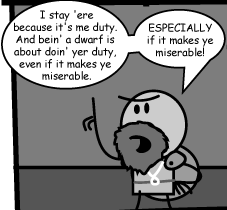 Durkon is ruled by tradition. The traditions of dwarvenkind. The traditions of his faith. Law and order – and more than them, duty and acceptance of one’s fate. It caused him to turn away from a chance at love. And, now, it caused him to reject a friendship and a chance at compromise, resulting in his death… and something much worse than death.
In some ways, it might not be a surprise that his moment of story took so long to arrive. Duty and tradition are far more subtle flaws than arrogance or bloodthirst or greed. It can be taken to extremes, yes, and we saw that fate, in far more stark relief, in the life and times of Miko Miyazaki. But for Durkon, the danger didn’t come out of a need to force such traditions upon others. It came, ultimately, from the need to be bound to such traditions himself.
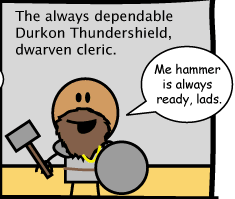
Perhaps this was a subtle commentary on the role of the healer in a D&D party, who often has to sit in the back and provide support while others have a chance to shine? Or maybe Rich just didn’t have anything interesting to say with Durkon, not until now. The story has been there, I’m sure, from the beginning… but until it came to its moment, perhaps there just wasn’t much else to do, save for Durkon to be the reliable fellow in the background. To remain “The always dependable Durkon Thundershield, dwarven cleric.”
Good ol’ Durkon.
Now, let’s say outright that what I love about Order of the Stick is that it always, always, is working on many different levels at once. So right here, we certainly have this awesome plot twist in terms of a character death, followed immediately by an even better twist in terms of their undeath. We have the inevitable conflict this will cause for the party, especially in light of their current struggle with Tarquin’s crew.
But we also get to face what this means for Durkon. Because this fate could, ultimately, cost him everything. He has had little to fear from death – indeed, death has always meant, for him, a chance to regain the honor he thought he had lost.
He was sent from home by the high priest of his people. He never knew why – never knew that there was a prophecy that he would return home and bring death and destruction to his people. All he knew was that he was cast out from the only life he knew, and finds himself wandering through human lands, essentially in search of atonement without knowing what he is atoning for, or why.
When the party visited the Oracle of Sunken Valley, he was told he would return home posthumously – what others might considered a depressing answer. But for Durkon, it was reassurance that he would be forgiven whatever had caused him to be cast out, and would be laid to rest alongside his ancestors at long last.
Or, as things stand, he might return as a ravenous, bloodthirsty monster, and unleash the very death and devastation upon his kin that he was exiled to prevent. As usual, trying to thwart prophecy very rarely works out.
Now, we don’t know that this will be his ultimate fate. The party might slay him and raise him and redeem him. They brought back Roy from beyond the grave. V was able to return to their ranks despite his own (far more willing) foray into damnation. This might be just one more obstacle for them to overcome.
Or… it might not. The party has been through a lot, and the stakes keep getting higher. Some losses stick, and this might be one of them. Not just because how well it fits with Durkon’s prophecy… but because of how well it fits with Durkon’s story itself.
As I mentioned earlier, every last one of the crew has undergone character growth and development over the course of the comic – except for Durkon. But it is more than that. They have all become deeply tied to the story – and to characters within it. Roy’s family has motivated the quest from the beginning. Elan’s brother and father are two of the primary antagonists of the series, and he’s had several personal arcs, from training with Julio Scoundrel to the sad tale of Therkla. We’ve only seen V’s family briefly – but V’s pursuit of power was a significant event whose ramifications are still being felt. We’ve seen Haley confront her own emotions over Elan, but we’ve also seen her confront her past – both the guild of thieves she once fled from, as well as her father and his imprisonment in the Empire of Blood. Belkar would seem the biggest misfit of the bunch, but he’s managed to nonetheless throw his lot in with the others, and has had several of his own ongoing subplots, from his changing philosophy to his own possible impending death. He has even formed a connection of his own, and even if Mr. Scruffy is only a cat, that bond is strong enough for them both to brave death to keep the other alive.
But what plots has Durkon had? His brief relationship with Hilgya Firehelm, which ended nearly 800 strips ago?
If you visit the Order of the Stick Wiki, they have compiled a very solid amount of background on each of the characters and their role in the story. If we focus on the depictions of what has happened for the characters since the story began, Roy clocks in with over 4,000 words. Elan is next in line with around 3,400, while Haley and Belkar are about 2,700. Vaarsuvius is in the back with not much past 1,500 words… save for Durkon. With barely over 300 words to his name.
Three whole paragraphs. That is all it takes to sum up Durkon’s role in the story. And why should it take more? The others are the central characters upon whom the drama is strung. Durkon is simply there to help them along the way.
Good ol’ Durkon.
Now the OotS Wiki was not written by Rich Burlew. It may not be an accurate depiction of the comic, but only how fans have perceived it. Yet… what can one remember about Durkon? With the others, there are plenty of struggles and changes that leap to mind. Yet Durkon… he’s been defined by a few amusing stereotypes and jokes – his accent, his hatred of trees, his dwarfy nature. Now, all the others were born from similar one-dimensional traits as well – but the rest of them have all moved beyond it.
They have developed as characters, and formed connections – to the story, to the NPCs, to the central plot itself. Durkon, tied so strongly to his principles and his faith, has rejected every connection that has gotten close to him.
And in doing so, put himself in the very situation where he is now – where he will unleash death and destructions upon his friends, and perhaps ultimately, upon his family and his clan.
So the question is – is this where his story ends? Does he end up trapped in the fate, either controlled by Malak or by the curse of vampirism itself? Has his time in the Order of the Stick come to an end, as he joins the cast of antagonists? Is this how he will fulfill the prophecy spoken about him so long ago?
Or is this instead where his story begins? Because that is the other option – that this is where we start to fill in all those missing connections for Durkon. That if he does manage to somehow survive this, whether by being restored to life – or even as a free willed undead… might this be the chance for him to finally start to grow and develop as the others have?
Or is all this conjecturing for nothing – since knowing Rich, he might have something even more devious in mind. Another twist that shakes everything up once more – and yet, ultimately, seems to fit perfectly with every single step that has come before it.
Because that, in the end, is one of the best things about OotS. It manages to constantly offer up surprises and shocking developments, even as it retains a pristine and powerful continuity from start to finish.
Nale’s clever and convoluted plans might inevitably end in failure, but Rich’s seem to pay off every time.
And that is just one reason why the Order of the Stick remains a damn good comic.
A few quick thoughts, before they become completely irrelevant…
Unlikeable Interests
I find myself torn about some recent developments in some of my favorite comic strips. Namely, Shortpacked (in which the previously insecure Amber blackmails the typically evil Mike into being her boyfriend), as well as Scary Go Round (in which the whimsically nice Shelly starts a civil war so she can get laid.)
Now, both of these aren’t completely unreasonable developments on the part of the characters. But they are, undeniably, developments that make the characters… well, a lot harder to actually like.
The actual results of the storylines are interesting, setting up the stage for big changes to come. Both of the comics are hardly ones to shy away from significant sudden shifts in tone, or the sudden removal or addition of key cast members, or so forth. The storytelling on hand is very promising and has my attention…
…even as I realize the characters themselves, however, do not. The most engaging comics – at least for me – are the ones where I have some investment in the characters. I can laugh about a character like Mike, but it is hard to get me to care about him. Not impossible, mind you – as Willis has shown before the last time someone blackmailed Mike into a relationship. Equal promise might be seen in this story… or it could end up with me losing all interest in the cast.
No idea which way it will go, and I’ve got concern and optimism balanced in mostly even measure. So, with some trepidation, I wait to see what’s in store for these two strips…
A Moment of Zen
I have less concern about Saturday Morning Breakfast Cereal, which I’ve found to be at the height of its game lately – this strip in particular I found to be brilliantly executed, and his guest comic for Dinosaur Comics was a rare (and excellent) demonstration that he can keep the humor coming for far more than a single panel.
Reborn from the Ashes
Back to mixed feelings as I take a look at the latest offerings of Sluggy Freelance… in this case the result of me trying to temper the immensely awesome recent developments with caution, given how often the comic has fluctuated up and down thus far.
Nonetheless, today’s reveal was an incredibly satisfying payoff to many, many years of plot. I am very hopeful that this latest storyline will really follow through and actually wrap up Oasis’s arc that has been drifting back and forth for nearly a decade now. It has certainly been an excellent resource for Abrams to keep returning to… but I think the time has really come to bring it to a close.
That doesn’t mean retiring the character, mind you – but Sluggy has a lot of characters who can’t really move forward so long as they are mired in the same plot again, and again, and again. Here’s a chance to break forward and keep the development moving forward. I’m eager to see where it goes.
Useful Tools and Other News
Become a Tool!
Erfworld has a new website, and it comes at a pretty key time. Order of the Stick – the main comic at Erfworld’s host for Book 1 – is going through heavy plot, and even upgrading to a new server is only going to go so far with the level of traffic the site is seeing. Erfworld itself is wrapping up the aforementioned Book 1 (The Battle for Gobwin Knob) even as it moves to its new site, and prepares for a less active summer followed by the start of Book 2.
But that isn’t the interesting thing about the move.
What catches my eye, instead, is their plan for financial support. There are many different approaches taken by many different webcomics – merchandise, donations, advertising, and often a blend of all of these – and there has been no one single road to success for those who are able to make a living from their work. Recently, I’ve seen more and more ‘subscription clubs’ offered, where the user pays a monthly fee for a variety of perks: often removal of ads, bonus strips, extra content, private forums, and so forth.
Erfworld now has its own: The Toolbox.
And it brings many of the standard bits of premium content to the table, with various extras, forum perks, ad-free browsing…
…and every single dollar you spend on the subscription gets turned into store credit, that you can go right ahead and spend on anything in the store you want.
Which is just awesome. For anyone who would have interest in buying their current or future products, there is little reason not to sign up. It is a fantastic incentive! It encourages both joining the club and buying stuff in their store, in a nice little profitable feedback loop. There is certainly no guarantee, of course, but it seems a pretty great offer for readers, and will hopefully be quite successful on their end. I don’t think any other webcomics have quite gone down this route, so I’m very interested to see how it does.
Kukuburi
This comic has returned! This is obviously good news. This is one of the few comics where what really wins me over is the art – most comics, I enjoy the art, but read for the story. This comic is the other way around – not to say that the story is weak, as I am enjoying it, but it is the gorgeously vibrant colors that keeps me coming back.
Whenever a comic goes on a hiatus – even a reasonably brief one – I tend to feel the need to read through the archives to get caught back up. With some comics, that is too much of a burden, and I either view it as an agonizing task… or a reason to simply ignore its return entirely. With Kukuburi, on the other hand, I’m all too glad for an excuse to dive back in.
Yet Another Starslip Crisis
The brave crew of Starslip have barely encountered a new and unique alien civilization before throwing the race into terrible and cataclysmic disarray.
Which is fantastic!
I had held faith, since the reboot, that the comic would continue to build up to the sort of powerful moments and significant beats that characterized the pacing during its previous, plot-intensive run. My wait paid off in the latest arc, which is suitably intense despite being self-contained… and also, I think, helps one of the more recent cast members to really find their niche in the group.
This remains a comic of superb craftsmanship, and that’s really all that needs to be said.
Visual Change
Penny and Aggie is hardly the first time that a webcomic writer has lost their artist and needed to shift to another. It isn’t even the first webcomic T Campbell has had in that position! And yet… in this case, it still feels like a very powerful blow to the comic.
In this case, the project was very much a collaboration between the two. T Campbell and Gisèle Lagacé both helped make this comic what it has become, and so losing one of the two was going to have an undeniable influence.
On the other hand, they timed the transition as perfectly as possible – following the culmination of the central plot of the entire comic up until now, nearly five year’s worth of development. The status quo of the strip was altered in fundamental ways, and this meant that pairing that change with a shift in the art would not be nearly as jarring.
And to be fair, up until day, it was working. I barely even noticed the change at first, as Jason Waltrip took over and found a style that closely mirrored Gisèle’s, and remained distinct enough from his other work to avoid pulling me out of the scene.
Until… today, a week into his run, when sudden cartoony elements completely throw me for a loop.
Now, this may well be intended – the comic itself has the characters suddenly acting far more cartoony and slapstick, and that may well be the direction in which they want to take the comic. Especially given that a break for some lighter fare is probably a good thing after the intensity of the previously mentioned plot climax.
But it is a fundamental shift in the tone of the comic… and, honestly, in the characters as well, who are really what the strip has been built around. And I can’t help but thinking it is something of a shame – the initial plot of the comic has finally been concluded, and only then did it feel like it was reaching the original promise and potential it had to offer… only to suddenly, with the change, shift gears.
That’s momentum it may never get back.
I’m certainly not calling it doomed yet! Nor rendering any final judgement for the current form it finds itself in. But I am certainly sad to see the change come, just when I had finally felt myself fully invested in the comic.
Abominably Good
I don’t have much to say this week, other than to share my latest webcomic discovery: The Abominable Charles Christopher. It is rare for me to add a new webcomic to my reading list these days (swollen enough as it already is), and even when I do find one of interest, it is typically a good bit of time before I get the chance to read through the full archives.
In the case of this comic, once I had seen one strip, I had to read them all.
A cast full of lively, talking animals (whose lives are filled with exactly the same trials and tribulations as our own) stands side by side with an epic tale of adventure for the titular character, a yeti whose silence and childlike nature doesn’t diminish his appeal to the reader in the least. Humor, philosophy and excitement – all delivered through absolutely gorgeous art – make me wonder why it took this long for me to discover it. For those who have also been equally unlucky, it begins here.
E is for Erfworld. Entertaining. Eccentric. Epic.
 It seems entirely sensible that Erfworld should be hosted on the same site that provides Order of the Stick, as they are both comics built on a blend of humor and plot set inside a world ruled by the mechanics of a game.
And yet… there are fundamental differences between the two. For all the humor in Order of the Stick, it took seriously the steps of laying the background for the plot and campaign. Laughs crop up even there, shortly, but it is trying to build a fundamentally sound world for the PCs to adventure in.
Erfworld, on the other hand, is a world populated by the absurd. It is populated by ridiculous little figures in a cartoon world, where the language is censored, the names are silly… and their lives are driven by constant and unending war.
The divide between the absurd and the dramatic is even wider than in many other similar comics. The silly cartoon people of Erfworld are indeed capable of complicated and emotional relationships… as well as feats of destruction on an enormous scale. Even as they are, at the same time, caricatures and parodies of pop culture, comic in appearance and built on a foundation of in jokes and obscure references. That juxtaposition is really the most impressive thing about Erfworld – than it can be filled with jokes like the Sofa King, presented as something as natural as breathing, even in the presence of mass warfare, struggle, and death.
That element has never been more present in the strip than now, as our protagonist, Parson Gotti, takes the game to a new level, finding a way to use the rules of magic to unleash a weapon entirely beyond the understanding of his opponents. It is a powerful moment and an incredible feat for him and his few remaining allies, to the no-doubt rousing cheers of the readers rooting for him.
Which is strange, in a way – Parson and those he works for are the bad guys, after all. At least, by the conventional standards – they use necromancy, have a host of standard creepy and evil monsters, and so forth. They are opposed by a coalition of standard good guys, aided by various elves and other more natural creatures, led by proper princely heroes.
And… all of that largely seems meaningless. We haven’t really seen any facet of lie on Erfworld outside of the actual warfare itself. It might be there – there are hints in the presence of the Magic Kingdom, in the fact that characters even can have relationship despite no real need for it (since people pop into existence, fully grown…) But everything we’ve seen is driven by the battle, and both sides will do what is needed to win it. Thus, does it matter what they are fighting for?
Sure, Stanley is a colossal tool. But so is Ansem, hero of the alliance. We’ve seen very few truly sympathetic characters… and we’ve tended to see them in equal prominence on each side.
So we root for Parson, because he’s the key figure, the protagonist. Because he’s the underdog, certainly, someone thrown into a hopeless situation and expected to win it. Because that’s how the classic tale goes – a hero from another realm is summoned to battle to save the day. Parson is the hero, and is given a magic sword, armor, and various other gifts, and is clearly going to be the deciding factor in the battle, the war.
And yet… there’s a twist. All those gifts are handy, but not the real weapon – that is his mind. Tactics, skills, and more – understanding his foes, and how to play them. Not just mastering the system, but thinking beyond it. Doing the impossible, rather than simply winning because he is chosen to win. Sure, in the end it comes out as the same thing – the author is the one deciding how the system works, and how effective any of Parson’s tricks actually are. But it makes for a more exciting story, and makes Parson seem more engaging that a standard hero.
Even if we don’t really get to know him.
We see the motivations of pretty much every character in the setting, from the petty to the proud. From those that are simply commanded to serve to those that are glad to do so – on both sides. And in many ways, Parson is just like the rest of them – he has to fulfill his orders, so he fights for his side to the best of his ability. It is his only hope of survival, not to mention any possible chance to get out of here – he has to win. And, honestly, he wants to win, since games – and figuring them out – is his life.
And that is essentially all we’ve seen of him. Is that enough? To simply have him be devoted to strategy and tactics? In many ways, we’ve seen more development and background from the characters around him, from his opponents, his allies, his henchman…
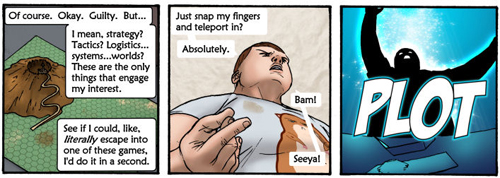 We have seen that he has grown close to the people on his side. Made friends, as much as the game really allows. He is fighting, by the end, for the chance for them to get out alive – even as he has to make decisions that will cost some of them their lives… or worse. Is this all we need to know of him? Is his life prior to this completely irrelevant, save for how bland it was? And, with the Battle for Gobwin Knob itself actually over, what will his path be to come?
That, really, is what is really pulling me into Erfworld right now. Sure, it is fantastic that it takes a funny world made by Elvis-based titans and populated by absurd little figures, and can make the reader care about it. But right now, the glorious thing… is that I don’t know where it will go from here. The Battle for Gobwin Knob is over. Our main foe, Ansom, is croaked. His coalition bested and in disarray. Parson’s master, Stanley, might still be out there – but he might no longer be Parson’s master, with Gobwin Knob gone. Parson might be free to do his own thing, and enjoy some time in the Magic Kingdom learning more about the system or trying to find a way home.
Or not. Easy ways out aren’t so guaranteed. He now has the emnity of every nation in the world. He has perhaps killed more than any warlord before him, caused personal trauma for many, and dealt losses even Charlie can’t ignore. And all he has is a handful of allies, who may not even have all that much reason to stay faithful to him. His one truly loyal friend was sacrificed in the final gambit. The Magic Kingdom itself doesn’t necessarily know what to do with him.
No, I don’t think there are any easy paths standing before him. But it seems like there is still a great deal more to come, and a great many interesting places for the story to go.
On Endings, New Beginnings, Gatherings, and Watchmen
Thought-dump this week, covering some recent (and upcoming) happenings in the comics/webcomics sphere. Next week, my thoughts on the (currently fantastic) webcomic that is Erfworld!
The End of Ugly Hill
I was first introduced to Ugly Hill when the Blank Label Comics collective started up. I was already familiar with the works of several of the creators (David Willis, and Kris Straub), and since their own works were very high on my list of comics, I felt any others they were joining up with were well worth checking out. And this was true – the majority of other comics in the collective were quickly added to my reading list, and Evil Inc, Ugly Hill, and Wapsi Square have remained on my list to this day.
But of them, Ugly Hill is the one that has most surprised me in its development. Evil Inc is a fun comic, but bogged down by a deceitful premise and a reliance on bad puns that always leaves me groaning. Wapsi Square started out brilliantly, and remains entertaining, but an ever-greater focus on the mythological has distracted from the core of relationships that is the strongest part of the strip.
But Ugly Hill… Ugly Hill took a cast of unsympathetic characters in a strange, terrifying little world (much like our own)… and made the reader care about them. Drew the reader in to even the most mundane of their stories, connected the reader to their most deranged goals… and left the reader rooting for them to come out on top, in spite of all the triumphs life (and their own failings) set in their way.
Ugly Hill is a comic about monsters, whose greatest failings – and greatest strengths – are that they are all too human.
And now the comic has come to an end.
It has been building for some time, and Paul Southworth, the creator, certainly gave fair warning. And the comic came to a satisfying end, with what seemed a logical conclusion for the characters. Not because their stories were over, really… but they had overcome the obstacles in their way. The comic was about the brothers Kilgore finding their proper place in life. About Hastings, an uncaring workaholic, finding something to care about. About Eli, an ambitionless loser, finally growing up.
Once we’ve seen where that tale leads, there really is no need to see what comes next. So while I’m sad to see Ugly Hill go… I’m glad to see a good webcomic come to a satisfying end, rather than abruptly being abandoned by the wayside, or languishing on well after its story has been properly told.
Paul Southworth shows us how to do it right, and that’s a damn good thing to see.
The New Digs of Digger
But to balance out that loss, a very nice gift has been given – Digger is free at last!
Digger has long been held behind the subscription wall at Graphic Smash. The subscription model for Graphic Smash (and the entire Modern Tales collective) was something that worked well… for a time. It was built around providing a lot of good comics, with the latest updates free but the archives requiring a subscription. The price was low enough that, given the quantity and quality of the comics, it was a reasonably good deal.
But eventually, burdened by poor site design and an ever-dwindling number of updating comics, the model seemed to be abandoned. Most of the comics hosted there switched to full access. Except… for Digger.
Which was an incredible shame. Both because it was a lot harder to justify that subscription for one single comic when it was original intended for a dozen or more. And, perhaps even more important, because of all the comics on those sites, Digger was the one I most wanted to see more people reading. I wanted to share it with my friends, to see people talking about it, chattering about the Shadowchild and vampire squash and all the other lovely bits of brilliance that make up Ursula Vernon’s delightfully smart comic. But… that’s hard to do, with a subscription wall.
So I’m very pleased to see the comic being given its own site, with the archives waiting for countless new readers to dig in! So if you haven’t already checked this comic out – now is the perfect time to do so.
New England Webcomics Weekend
This weekend is the NEWW, which I’m ever more convinced is the work of mad scientists. Think about it – concentrating that many deranged webcomickers in one space, at one time… I’m predicting a singularity of creative madness spontaneously forming, and wiping out the entire eastern coast.
If that doesn’t happen, though, I’m instead predicting a lot of ridiculously entertaining stories emerging from this gathering. I’m looking forward to hearing tales of this event echoing through the interwebs for weeks. While just a bit too far afield for me to venture there myself, I’m expecting the aftershocks alone to provide plenty of inspiration to the artists in attendance, and plenty of fun for readers in the days to come.
Watchmen
So yeah, there was this movie, based on this comic book, you know? It was pretty good, I thought.
I mean, it wasn’t perfect. Plenty of little flaws, plenty of room for improvement. A couple stylistic choices that undercut core themes of the work. A few powerful moments conspiciously absent or altered. But the most basic ideas were still there, still intact, and still came across on the screen. The characters were well done, and their stories were well told. Visually impressive, and structurally sound – given how low my expectations were going in, that was more than enough for me to leave feeling well entertained.
But the movie itself aside, I found myself quite interested in seeing the movie’s presence ripple through the blogosphere, leaving a variety of parodies, commentaries and other amusements in its wake. The two that most caught my eye:
Ombudsmen, in which Scott Kurtz sets the core cast of PvP aside for a week to re-cast Watchmen as a referential work on newspaper comics, rather than comic books. Brilliant concept with excellent execution. The second strip, in which the eternally frozen nature of decades-long newspaper characters is connected with Dr. Manhattan’s cross-time viewpoint and his nature as an immortal yet static being… is simply flawless. It works on every level – as a respectful parody of Watchmen, as a commentary of the medium, as an engaging moment in its own right. This is some of Kurtz’s best work, and leaves me hoping for more self-contained (for certain values of self-contained) strips in this vein.
Saturday Morning Watchmen, on the other hand, is simply hilarious. A short animation that asks what it might look like if they had made Watchmen into a kid’s cartoon, the answer is in many ways terrifying – and yet, I’m sure I would have watched it in a heartbeat.
When Watchmen originally came out, it helped alter the comics industry in fundamental ways, giving rise to years of grim comics that tried (and often failed) to look at what a world with superheroes might really be like. I’m glad to see the emergence of the movie instead having (at least initially) more of a legacy of entertainment and humor, instead.
D is for Dracula, Distantly Destructive
 So there’s this comic called Dr. McNinja. When first I encountered this strip, I could describe it as little more than a comic about a doctor, who is also a ninja; or in short, a comic about being awesome.
Since then, the description has proven even more accurate than I could have imagined, since this truly is what the comic is all about – the Rule of Cool. The principle, largely, is that you take a bunch of elements that tend to stand in their own genre – such as ninjas, or robots, or wizards, or whatever – and then you throw them together, producing something that is, in theory, profoundly awesome. Imagine: a time-traveling wizard cowboy, trained by monks in the arts of karate and meditation! And so forth and so on – these characters and scenes are driven more by the sheer concept of them than any actual merit of their use. And this is entirely ok – there is nothing wrong with simply sitting back and appreciating the sheer brilliance, say, of tyrannosaurs in F-14s.
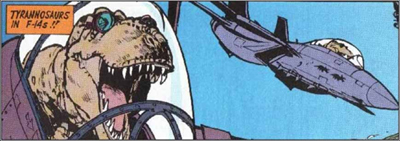
No one knows awesome quite like Calvin and Hobbes.
Now, what I find makes me really, truly appreciate Dr. McNinja is that it manages to take these concepts and actually make them work within the story. It has been pointed out that more than a few fans will tend to defend a work by pointing at the bits of “awesomeness” within – but that it takes quite a bit more to make such concepts actually work within the story, rather than exist as a single moment of fun entertainment. Which Dr. McNinja succeeds at – indeed, by this point, the vaguely surreal setting of the comic has become so fundamental that the continual appearance of ghost wizards and robot bears seems not just acceptable, but downright natural.
And there are actually long, elaborate plots built around these concepts – the main characters themselves are all equally absurd, but nonetheless have managed to become well-realized characters with that the reader can be fully invested in. So this is why Dr. McNinja rocks. Also valuable: knowing exactly how far would be too far.
Now, the comic continually seeks to offer new moments of awesome – a challenge that grows ever more daunting, given the various scenes and characters it has already gone through. Among the most recent highlights in the strip was one moment that outshone all others – in which, when Dr. McNinja goes hunting for Dracula, we learn that Dracula has a moonbase, and is able to eliminate vampire hunters via his moon laser.
So, given that this was a moment of crowning awesome in a comic fundamentally built upon such principles, it was with quite a bit of shock when I discovered that self-same scene, last month… in the pages of Marvel comics.
One comic in particular: “Captain Britain and MI13”, Issue number 10, written by Paul Cornell. In a time when I’ve found very little to be excited about in the world of print comics, this series has been one of the few that have stood out as entertaining and worthwhile. This opinion was only further reinforced when this most recent issue opened with a chat between Dracula and Dr. Doom – on the moon. And even more so, when Dracula then returns to his private moonbase, from which he fires not a moon laser, but instead magical cannons that launch exploding vampires at his enemies on the Earth below!
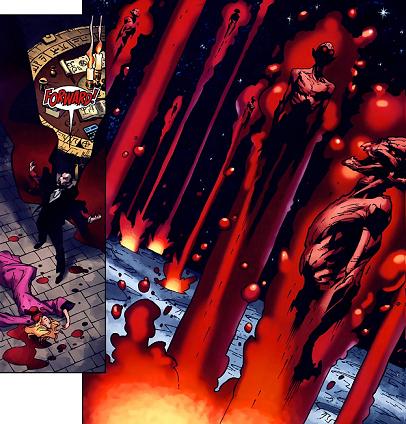
If you're gonna be a villain, it's always best to do so with style.
Now, I don’t know if this was done as a reference to Dr. McNinja, or simply the product of two great minds thinking alike. It really isn’t important either way.
What I do find important is this: When the topic of comics comes up, amongst my friends and I, there is quite a lot of talk about webcomics. Discussion over current plots, new webcomics people have discovered, or even simple appreciation for the comics that are always reliably good. There is almost no discussion at all of print comics – and when the topic does turn to such things, it is almost entirely negative.
Pretty much every single one of my friends reads webcomics, and enjoys them. Almost none still read anything by Marvel or DC – and even when there is both good and bad works being produced by both companies, it is only the news of the worst of it that filters down to our topics of discussion. And while I try to talk about some of the worthwhile comics of recent years – Blue Beetle, Iron Fist, etc – it is hard to do so. They are familiar with the big names, and so they can get frustrated at hearing about poorly-written stories dealing with Batman or Spiderman. It is much harder to get interested in hearing about well-written stories about characters they have never heard of.
But when I can point to a comic, and say, “This comic features Dracula and his moonbase, just like in Dr. McNinja!”? That, they get. That, they can understand. And that has a bigger chance of getting any of them back into comics than any big event, or crossover, or crisis. In all honesty, the vast majority of those have only served to drive them away.
I’m not saying print comics need to directly imitate webcomics in order to succeed. Honestly, just writing decent stories is a pretty basic step one – though one that a lot of comics seem to have quite a bit of trouble with. But tapping into the same level of innovation and creativity as what can currently be found online certainly helps get my attention, and seems like a pretty good step in the right direction.
C is for Crisis, Cleverly Cropped
 I’ve long been impressed by Starslip Crisis.
It has always had exceptional production values – clean art, reliable updates, a strong focus and engaging characters. It started out as a strip about the Starship Fuseli, a museum (in space!), and the quirky group on board – a pretentious curator as captain, an ex-pirate as the pilot, and a strangely-innocent insectoid alien as the staff. Plenty of room for humor, and that was the core focus for quite some time – and the strip continues to deliver that to this day, with a punchline in (almost) every four-panel strip. Kris Straub’s previous work, Checkerboard Nightmare, certainly got solid attention in the webcomic community – but I think Starslip is really where he hit his full stride, and delivered a masterwork.
But while the initial comic was well-crafted and had a definite degree of charm, what really made it stand out was when it began to truly develop those characters… and the story itself began to take on more epic concerns. The name of the comic – Starslip Crisis – came to full meaning when it was revealed that the commonly used method of space transportation (‘starslipping’) had certain… problems. It turns out that tapping into parallel universes for your own personal convenience is never a good plan.
Events build from there. The humble crew of the Fuseli has to confront insane space tyrants, the greed-driven corporations that run the government, and an army of space-cops from the future. There was excitement, there was sorrow, there was conflict – all remarkably well-executed, all entertaining to watch.
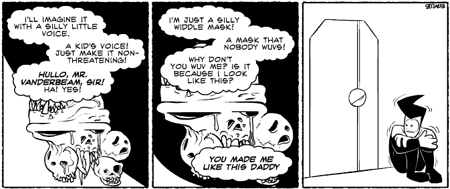
Sometimes, psychology can only get you so far.
But… over the last year or so, the focus started to drift. The cast was split between several locations, and the standard interplay between the characters – which, honestly, was really at the heart of the strip – was lost. There were plenty of good moments during this time – I consider the tale of the Dreadmask to be among the funniest moments in the strip. But while Straub’s humor continued to hit the mark, the strip’s current state left him with several challenges. The storyline had gotten more and more convulated – it remained remarkably straightforward for anything dealing with time-travel and parallel timelines, but that was still complex enough to present a hurdle for new readers.
The strip had started with a wonderfully simple premise: “A museum in space.” Now, how many words would it take to describe the comic? There was no longer a single focus, nor even a single location or cast the comic was built around. Even the plot itself presented a hurdle – the present had gone to war with the future, and reached a bitter stalemate. One side didn’t have the power to hurt the other; the other side didn’t dare risk using their power for fear of wrecking their own past. How do you resolve that? Finding an answer to that dilemma was challenge enough alone.
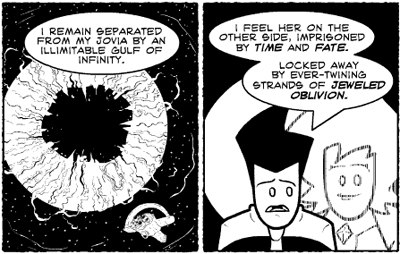
Memnon's flair for the dramatic is often played for laughs - but sometimes, that eloquence is the only thing suitable for the occasion.
All in all, the problems weren’t large enough for me to really feel them impeding the flow of the strip – yet. The story remained potent, especially to someone who had been reading long enough to forge connections with the characters and the plot. But when Straub decided the best thing to do would be to reboot the strip, solving all his problems in one fell swoop – while also giving him an easy excuse to update the visual style of the comic – it seemed not just a reasonable decision, but an inevitable one.
Straub wrote an enlightening article on exactly what was going through his head as he took stock of his comic, why he decided a soft reset was needed for the strip, and where he wanted to go from here. The reboot itself was carried out masterfully, worked smoothly into the plot in a fashion that felt like an excellent culmination of all the recent events in the strip … even as it undid them.
The in-story justification of the reboot is that the characters escaped a dying universe by slipping into a parallel timeline – the only one they could find that avoided the pitfalls that destroyed their own timeline. More specifically – shifting them into that timeline, two years back. There are already differences, and they only grow larger as history begins to repeat itself – and just as quickly is derailed, as the crew puts their ‘future’ knowledge to use.
In doing so, they don’t just stop the plans of an insane time-traveling tyrant… but they also stop the series of events that had led to the comic growing so convoluted. No war with the future, no divided cast, no diminishing of the core concept. Indeed, it soon looked like everything would return to the status quo, and the comic could be described just as succinctly as when the strip began. And it should be noted – it would be easy to see this as rendering the events of the lost timeline meaningless, but Straub manages to keep them relevant – through the characters themselves. Because whatever timeline they are in, the growth and experiences of the characters remained intact, and could still be seen through greater competence, deeper concerns and, in many ways, a stronger awareness of their own natures.
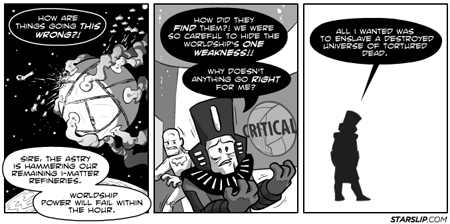
Some guys, you just can't feel sorry for.
But even with a reboot, the strip can’t stop in stasis forever. Even as Straub brings things back to the original dynamic of the strip, he did something I wasn’t expecting – and ditched the Fuseli. The space museum is retired to orbit Earth, while the crew moves on to a fancy new ship with a fancy new mission, as diplomats (in space!) It might not be the original pitch, but it remains an equally concise one. Less unique, certainly – but the comic has already established itself, and is able to stand out on already proven merits alone, rather than the need to fill an otherwise unoccupied niche. As I said at the start of this post: the strip has clean art, reliable updates, a strong focus and engaging characters – and has now shown its capacity for a well-woven and compelling plot.
So what is the point of this post? In short – taking risks can be well worth it, something I know I’ve commented on before… but nonetheless remains true. Whether evolving as an artist or being willing to change the dynamic of your strip, you shouldn’t be afraid of pushing yourself and your work into new territory. It doesn’t always pan out – a new plot might fall flat, a new style might alienate readers. But you can respond to that, and take what works and what doesn’t, and end up with something greater than it was before. If you don’t change, if you prefer to let the work sit in stasis… well, it won’t kill the comic. If it is good to start with, or even simply decent, then it is likely to remain just as decent for years to come.
And eventually, perhaps, that leads down the route of so many newspaper comics – with the strip ending up as a nice simple formula that churns out work that is entirely acceptable, but never truly exceptional.
Starslip dares to be exceptional.
B is for Belkar, Belligerently Badass
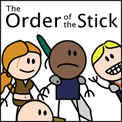 I never liked Belkar.
It wasn’t because Belkar was a one-dimensional character – as, in Order of the Stick, that was essentially true for all the characters in the beginning. No, it was simply due to what Belkar’s one dimension was – a homicidal jerk. A character whom the rest of the party only tolerated because… well, largely because that is what actually happens in gaming. It doesn’t matter if the rest of the group wouldn’t actually adventure with the maniac someone else decided to play – you are supposed to be a group, and find a reason for the characters to work together. So it goes.
And so Belkar got to be a bloodthirsty bastard who cared for no one but himself, and provided very little to the rest of the group (other than his natural skill at violence), and who was only really with them in order to indulge in that self-same talent. I’m sure he had his fans, but I didn’t really like the character, and looked forward to seeing him get his inevitable comeuppance.
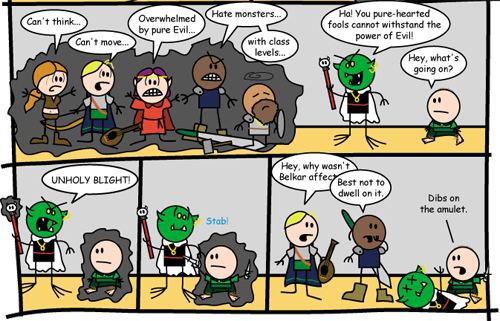
Always look for the silver lining! In your, uh, clouds of pure evil darkness.
But in the beginning, it didn’t really matter that he wasn’t a very likeable character – he was there to help serve certain punchlines, and did the job well. I didn’t need to like the character to laugh at the strip or appreciate the jokes. He filled his role well… right up until the tone of the strip shifted. As the first major arc of the strip began to draw to a close, the focus began to change from the daily punchline to the goal of an ongoing story. Humor was certainly still present… but many other goals came to the fore.
And Belkar was still just Belkar. And a character that worked well in a purely humor-driven strip was suddenly much less fitting in a comic dealing with continuity, coherency… and character development. It was, in short, a classic Bun-Bun Dilemma.
Bun-Bun is a character from Sluggy Freelance, one of the longest ongoing webcomics around – and one that has long struggled with the division between humor and story, with Bun-Bun a classic example of the potential difficulty in resolving that conflict. Bun-Bun is essentially the iconic cute by vicious little fellow – a rabbit that appears cute and fuzzy, but is all about violence and greed and self-interest, and is badass enough to actually follow through on its vicious nature. You might notice this description (aside from the ‘fuzzy rabbit’ part) almost perfectly matches Belkar – and plenty of other similar characters in other comics, cartoons and the like.
The key is, having a character with such an inherent contradiction tends to be, well… funny. The jokes practically write themselves, and such a character is a fantastic source of ongoing and reliable humor.
But once humor becomes secondary to the strip… what else is left for that character? In Sluggy Freelance, for Bun-Bun, the answer was… nothing, really. The strip has wrestled for years with what to do with the character, and found some success in casting him as an antagonist – and eventually even built up a fairly intense storyline culminating in the character being hurled out of the strip itself.
Perhaps the best possible end for the character – but, like a bad habit, Bun-Bun eventually came back… even though there really was no good place for him. He couldn’t be given any character development – it would have gone against his very concept. The only role left to him? To randomly show up, utter his usual threats and insults, recall the same tired jokes that he was created for… and then step offstage again.
And this was the future facing Belkar.
Don’t get me wrong – these characters have plenty of fans. Bun-Bun’s legions of followers will endure long after the rest of Sluggy Freelance is forgotten, I imagine. The concept is more succinct, more marketable, more independant than the story the character was placed in – and that’s why the evil little ball of fur will keep showing up long after the comic has actually had a use for it. Similarly, many have been fans of Belkar despite his self-serving and homicidal tendencies. I imagine many have been fans of him because of it.
Which is where the dilemma comes in. How do you keep the character in the strip when having their development keep pace with the rest of the story would destroy the very essence of the character – the very elements that all their fans care about?
The approach in Sluggy Freelance was to make Bun-Bun an adversary, and Belkar could easily have fallen into that role – except that part of the character’s core was being one of the PCs. So a solution needed to be found that would let him remain a member of the party, despite the fact that no sane group would truly keep him around longer than they had to.
Fortunately, it is a comic in a fantasy world, which means “A Wizard Did It” is a perfectly acceptable means of finding a solution to a problem. Belkar gets tagged with a magical curse to reign in his murderous capabilities, and keep him working with the party – still free to spout insults and be his usual charming self, while allowing him to legitimately function as part of the group.
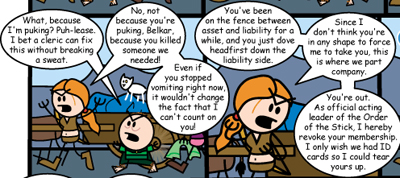
It's ok to be evil - as long as you stay useful.
An elegant solution… but not a permanent one. The rest of the group was continuing to develop and fit into the story, while he was just being dragged along, more of a plot hook than an actual character. Which is when the comic’s esteemed author, Rich Burlew, began the real challenge – finding a way to redeem the character. Finding a way to make him truly part of the group, a character who both had reason to work with the rest of the group, and was someone whose presence they would welcome in their midst.
Over the last fifty or so strips, Belkar’s tale has unwound, as he is taken as low as he can possibly go – crippled by the curse upon him, the others finally realizing the want nothing more to do with him, and… oh yeah, a rather dire fate awaiting him.
Now, with most characters, this would be the perfect opportunity for redemption. For the character to realize that they only got this far through the help of their companions, and that living a life based on selfishness and impulse has only left them cursed, friendless and alone. And the character would rise up, having learned The Meaning of Friendship, and put their conflicted past behind them!
But… Belkar has no conflicted past. He has never wrestled with any moral dilemmas. Immoral ones, sure – but there has never been the slightest bit of selfessness in his character. Having him become a decent fellow would be a complete contradiction with the very core of the character!
Yet Rich figured a way out. You don’t have to be Good in order to perform Good acts – you just need a good enough reason to do so. Belkar learned that lesson before, when he saved a paladin from an assassin in the hopes of getting his curse removed.
Rich might not be able to change Belkar’s self-interest, his greed, his lust for violence… but he could change his
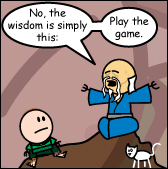
Knowing the rules doesn't limit your options - it expands them.
impulsive nature and his antisocial tendencies. Belkar, crippled by his curse, barely hanging on to consciousness, reaches an epiphany – he doesn’t have to actually follow the same moral code as his companions, he just needs to fake it. He calls it “faking character development” – but the development is there, just not what was expected.
It’s a realization that he can get farther in the world if he has people who can – and will – watch his back. All he has to do is give them reason to keep him around – which he can already do, due to his skill with a blade – while not giving them reason to kick him out. Which does mean he needs to refrain from murdering anyone who momentarily pisses him off, and cutting back on being completely abrasive to the rest of the group – but in the long run, he realizes, it is worth it. And given the life of an adventurer, he knows he will have plenty of foes whom he will not just be allowed to butcher to his heart’s content – but even rewarded, even celebrated, for doing so.
He has successfully known character growth. Not from a villain into a hero (or even an anti-hero), but from a wild, erratic murderer driven by little more than impulse… into something resembling a magnificent bastard. As long as he acts with style and stays a team player… well, it has already paid off so far, in spades.
And it makes him interesting. And it lets him keep his spot in the party, and keep his role in the story. And it makes him, despite his nature, someone the good guys can cheer for. I may have hated him throughout his career – but when he hopped to his feet and started eviscerating rogues, demonstrating his sheer level of badassitude, on behalf of a righteous cause… well, I was rooting for him all the way.
We’ll see whether he can carry this out indefinitely – violence might solve most problems in an adventurer’s life, but not all. I’m sure there will be times when putting up with the moral outlook of the party might be a challenge – but then, conflict is the core of a good character. And – in many ways now more than ever – conflict is what Belkar is all about.
 Damn Good Comics