I like the name, even if I don’t understand it
 A month ago (to this day) I recieved my first request to take a look at a specific comic, so now seems a proper time to do a review of it.
The comic in question is called the Flowfield Unity; the man behind the comic is one Adam York Gregory, an impressive name in it’s own right.
It began, as I understand it, as a print comic that is now being posted to the web. Much like others who have done the same, as well as the countless ones that have done the opposite, it shows that it is quite feasible for a comic to work equally well in either medium.
As for the comic itself, it definitely has potential.
Potential is a funny word. While technically complimentary at its core, it comes across much harsher. After all, saying that something might eventually be good is simply a roundabout way of saying it isn’t good right now, yes?
So I don’t want anyone to get the wrong idea – I definitely like the Flowfield Unity. It has been a little hit or miss to my tastes, with some strips going over my head and others just falling flat. One of the most visually exciting ones left me indifferent as to the actual content.
But for each one of those, there would be another one that I found exceptionally clever and insightful and amusing.
The larger portion of the strips, though, the largest feeling I felt… was potential.
It comes down to rhythm in a lot of ways. The strips from the very beginning involve exceptionally cool concepts, but they don’t quite convey them with the same beat, the same punch as does xkcd or the Perry Bible Fellowship.
They are well-crafted, there is no denying it. When I look at the first strips, I get the sense of nothing so much as visual poetry, illustrated haikus. That is hardly anything to laugh at – and therein lies the problem.
The strip revolves around the premise of turning ideas on their head, and presenting concepts broken ever so slightly askew. But the cleverness of such things will only take you so far, and without the humor found in those oddities, it will be hard to truly leave an impact on the reader.
Of course, there is only some twenty-odd strips in the archive at present date. The beat of the strip may very well change, and start fully delivering on the possibilities it touches upon. May already have done so, in fact, given he is drawing from an already published resource that consists of a much larger body of work.
For right now, though, it remains worth reading. Sometimes it won’t do much for me, and sometimes it will deliver something that genuinely leaves me smiling.
Right now it is a comic with potential, and that is nothing to be ashamed of.
Minus
Do you know what comic you should be reading?
I know what comic you should be reading.
You should be reading Minus.
Minus is the story of a young girl with incredible powers, who goes about the business of… well, of being a young girl who happens to have incredible powers.
The comic is Count Your Sheep meets Calvin and Hobbes meets xkcd. Filled with a mixture of the strangely horrible, the beautifully profound, and the absurdly whimsical, the comic is genius from start to finish. The concepts are incredible, the art (hand painted!) is gorgeous.
I know of few other strips that can tell a story to break your heart in three simple strips.
It isn’t a long read – the comic only has 41 strips to its name. But I can’t proclaim it’s greatness enough – all I can say is that, right now, you should be reading Minus.

Moments on a Monday: Shit Happens
 I’m beginning to become depressed by how many bad webcomics I find myself enjoying.
Shit Happens is the latest in the line-up.
The comic itself, as many do, starts with random roommate humor and hilarity, and then somehow finds its way to exploring dark and intense drama, with the requisite blood and glory that entails.
But as much as I hate to see that sort of thing happen, eh, it doesn’t really frustrate me – man wants to tell a more serious story, more power to him.
What bugs me is the main character.
Halifax.
You see, Halifax is a Gary Stu, which I just learned is the term for a male version of a Mary Sue, thanks to the wonders of the internets.
To quote wikipedia: “Characters labeled Mary Sues, as well as the stories they appear in, are generally seen as wish-fulfillment fantasies on the part of the author.”
It irks me. It is one of the single biggest pet peeves I have with webcomics, and largely because I keep running into it, over and over, and it invariably is the single biggest thing that keeps the comic from being a quality piece of work.
I read a handful of other comics that are offenders. Ctrl+Alt+Del has been well-famed for it, and seems, at least of late, to use that element almost self-referentially. Least I Could Do is practically built around it as a core concept. And even with those two comics, which do it about as well as it can be done, it makes me want to shake my head and walk away when I see it in action.
Halifax lives up to all the expectations. He treats his friends like dirt without them actually, say, stopping to be his friend. His job consists of not doing anything and getting paid tons of money for it. Pretty much every female character in the series has been in love with him at some point. Did I mention in his past he was a secret agent, for no apparent reason?
Anyway. We’ve got a comic with a lame and cliche plot, with a main character who fits every archetype I despise about main characters. Yet somehow, by the time I finished the archives, I find myself enjoying the comic.
Why?
Well, the main problems aren’t quite as terrible – the plague of drama has wandered off, leaving the crew mostly meandering through life – which I find far more engaging then mafioso deals and back-alley shootings. Our ‘hero’, Halifax, remains a pristine asshole, and the friends he so mistreats seem unable to do anything about it despite being in a position of power over him – but baby steps are fine.
No, I find myself far more interested in the side characters. Former villains seeking a better understanding of the world. Demonized ex-girlfriends now offered the possibility of redemption. (Both featured in the picture above.)
Now, both of these characters suffered from being forced into the formulaic drama that dominated the strip for so long. (And for at least one of them, it was a terrible disservice to their character’s representation up until then.) But I’ve found the small dwellings on their current state, and the possibly of redemption for the two of them, to be strangely compelling.
On the one hand, I know that that plot element itself – that of ‘redemption for the fallen’ – is itself formulaic in many ways. But even with the build-up from the rest of the comic, and walking into the scenes dealing with those characters keeping that in mind… I found myself engaged, and actively interested.
That was a surprise, and surprises can be good things.
So there it is – not exactly the most inspiring review, I imagine. I generally try to avoid too much naysaying here – if I have a comic that I honestly can’t find anything good to say about it, it isn’t worth the time to do so, as much desire as I may have to rant about it. Even the trashiest comics are the product of hard work and a story that someone, somewhere, is proud of, and I don’t feel it is my place to do nothing but sit back and rag on that. (Cept Megatokyo. I kid, I kid!)
But here you have a comic that starts off weak and walks into the pitfalls that many have before it. And at the end of it all… well, at least for me, I found a faint spark of quality, enough to keep me interested. I can’t promise it will make the best reading experience for anyone, but it was enough to give it some recognition.
And that’s definitely better than nothing.
Lightning in a Bottle
I’ve spent the day rereading through Squidi’s A Modest Destiny.
Now, Squidi’s has gotten a lot of flak for various things in the past, but the comic itself is, in my opinion, a pretty damn good one. Pixel based art that is quality – expressive and interesting and diverse characters, backgrounds and scenes. That’s not easily done, and a lot of people overlook the quality simply due to the medium alone.
Even more than that, it is a good story with good characters. Sometimes it falls into formula – but one that fits smoothly within the essentially video-game RPG world it has set up for itself. It works, and I was glad to have the comic return, because the story really dig grab me up and leave me eager to see how it all ends.
It’s not a perfect comic, admittedly, but there are no really glaring problems that leap out of the page at me.
…
…well, ok. Maybe just one.
See, he has trouble writing the crazy.
Now, I’ll be the first to admit that madness is a damn hard element to capture in a character. Convincingly showing someone as crazy is never and easy task. Sure, some can pull it off on a regular basis, but that’s usually the product of a powerfully intense and creative mind.
And I am willing to allow him some leeway, because he isn’t just arbitrarily throwing in a crazy dude for shits and giggles. The crazy dude in A Modest Destiny is a combination of victim and plot device – there is both legitimate reason for his insanity in character, and deliberate use of it to further the story.
 Unfortunately Squidi has trouble with, well… portraying the madness. The only way he can think of to do so is through the same fail-safe most people fall back upon – random gibberish.
Now it might just be me. I mean, sure, there are crazy people in real life do just say random crap all the time. I am not an expert in that field, but it is not an entirely illegitimate portrayal of some varieties of insanity.
But nonetheless! It doesn’t work for me. It feels forced, it feels arbitrary… it feels lazy. Rather than try for convincing dialogue, the artist just puts in words. Any words, any topics, any concept that pops to mind. Bam! Cheese monsters devour Denver with perplexity! Done.
Now, I mentioned before that our good friend… Pippity Bobo… is occasionally used as a plot device. The old ‘crazy guys hears voices, and some of those voices say important things.’ A time honored tradition, really, and Squidi does a better job with it than the normal randomness. It still isn’t flawless, and often feels a little forced with his ‘cryptic advice’ – but I much prefer having a guy who clearly has something important to say, but is genuinely unable to directly say it. And is more frustrated by that his listeners. When it seems that he isn’t just speaking random words, when he is honestly trying to communicate as best he can, but is limited almost as much as if he was speaking another language entirely…
…well, that has context. That has a grounding in his setting, and his character, and his relationship with other characters. And it is that sort of context that makes madness something interesting.
So I’ve got hope that Squidi’s eccentric little madman will keep developing, and maybe find a bit more of a method in his madness. If not? Well… it’s just one character, and one irritation alone won’t break me out of the story.
And if he does pull it off? Then that’s more than worth the trouble getting to that point.
Madness is difficult to master, but if you can accurately portray that combination of disconnection and genius? Convincingly get into the mind of something that is a half-step to the left of our own mental workings, and then draw out that disruption for us all to see?
Then let me tell you – you’ve got it made.
Andie Again
I’ve been following Flint Again for a while now, and it hasn’t failed to disappoint. As usual, Troutman is a good storyteller, and even though we’re delving into the backstory of characters from his previous works, it manages to be pretty new and exciting at every turn.
But what recently has really been getting my notice isn’t the character development and the ability to see some of the defining character moments and first meetings among the crew – it’s the art.
Now, John Troutman has had more than a few webcomics. Many of them have been successors or side-strips or prequels or sequels or all manner of interconnected works – but they have each been pretty distinctly different. His art style is constantly changing – in some cases simple improvement, in some cases simply trying out different styles and techniques.
His latest style is much more intensely detailed then his previous works. It’s a good style, and works well with moving from pure comedy to a more story driven setting.
The only thing I had found slightly disconcerting was the way he drew the faces – adding in some prominent cheekbones on many of the characters was mildly disorienting. But my uncertainty about the new style was blown out of the water when I saw the latest update – which features our first scene with Andie.
Now, Andie was never really my favorite character in the strip. I mean, I liked her, but she just never pulled me in as well as some of the others.
I think, though, that has now officially changed.
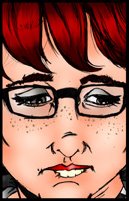
 The image on the left is the one that Troutman has been using to represent the latest update – on the Keenspot newsbox, on his own update page. Its a good image, and its definitely cute.
But it’s the image on the right that won me over.
Troutman was able to capture an incredible depth of expression with this new style. I’m not even going to get into the new look for Andie – other than to say that it works, and works well – but just with the face alone, he seems to have caught a moment of real honesty. Real feeling.
That’s hard. That’s a challenge no matter what style you’re using.
I am confident that this is by no means the final stage of his artform. We will see it continue to evolve throughout this work alone, let alone any projects that follow. And that’s good – that’s a good thing.
But right here, right now, he got it right.
Andie was a prominent character throughout almost all of his previous works. She even had her own entire spin-off. She had, arguably, a more complex background than many of the other characters. Througout all of that, though, I never really got her. Never felt any great attachment.
4 pages. It took him all of 4 pages to change that.
Now that’s skill.
What, exactly, does a non-adventure consist of?
 It is rare for a webcomic to win me over instantaneously – yet I should have known to expect no less from any product of the diabolical mind of Justin Pierce.
Most webcomic parodies riff on Batman. And hey, that’s all well and good, it’s damn funny stuff. Superman makes the rounds as well, and again – good stuff. But once it’s been done… well, it’s been done.
So maybe that’s why Wonderella stands out right off the bat. Or maybe its the suprisingly well crafted facial expressions? The cluelessness of our heroine? The witty alt-text? The 500 bears??
Does it matter? The comic is good stuff. Give it a whirl.
Digital Poetry

It is possible, certainly, to appreciate webcomics – or any type of story – by oneself.
However… webcomics are a story that unfolds over the course of time. New developments every week. Constant changes, speculation, excitement – all elements that breed discussion. Even strips that aren’t anything more than a punchline a day still bring out the need to chat about them. To share the joke, have others recognize the humor.
I read quite a lot of comics. It seems inevitable that I should do my best to try and foist many of them upon my friends.
That latest in this vein has been xkcd. Hardly the most typical of comics, it describes itself as a webcomic of romance, sarcasm, math, and language.
A simple description? Not so much. But it may be as accurate as one can get. The comic waxes from philosophy to parody to gaming references. It deals with Science. With Math. With Velociraptors.
This is not an easy comic to categorize. This is not even a comic for everyone – it will consistently have jokes that I just don’t get. (And I consider myself a rather bright individual. Humble, too!)
But I still read it. For every comic I don’t get, there is another brilliant one that I do.
When I first read the archives, I didn’t like it. I started at the beginning, which was the real problem. The early strips are relatively weak and unfocused, and somewhat… tainted my reading of it all. But I kept my eye on it. There had been a few gems, and his parodies of other webcomics were picture perfect.
Sometime later… I returned. This time I started at the latest strip, and went backwards one step at a time.
The grin never left my face.

There are comics where even if you don’t get the references, the context, you can still generally find humor in them. A good example of that would be Penny Arcade (which xkcd seems to have an extremely creepy love/hate relationship with). For myself, contrary to the strip’s opinion, I’ve found that I can certainly appreciate PA strips about games I’ve never heard of. I may not get the full meaning, but there is more often than not some extra punchline to keep the smile on my face.
xkcd, on the other hand? I’ll probably scratch my head, shrug, and wait for the next one. Someone, somewhere, is rolling on the floor laughing at it.
It just isn’t me.
(This, by the way, is one of the reasons I most desire infecting my friends with love for this comic. Our knowledge base – like that of many geeks – covers many and sundry topics. It is almost a certainty that no matter what we are discussing, one of us gets to just sit back, smile, and pretend they know what the hell is going on.)
(Anyway. Back to the show.)
I like the unpredictability of xkcd. I like how easily it oscillates from horrifying to humorous, from uplifting to surreal. But no matter what it does, it does it well.
So I’m doing my best to share it with my friends. If they do start reading? Well, there will be days when I laugh at a strip that leaves them shrugging, and days when they nod sagely at wisdom I just don’t see.
But just maybe, every so often… we’ll both get it. And even if there isn’t much to discuss, even if there isn’t anything we can do on our part aside from acknowledging it – it will be nice, just having someone else there to say: “Yeah. It’s not just you. That strip really was simply awesome.”
The Inevitable Changes
 I started reading Yirmumah again.
I had stopped reading it, some ages past, after D.J. did something arbitrary and assholish, and I figured it wasn’t worth my time to read something put together by someone with so little class.
But… well, he doesn’t seem quite so bad these days. Few in the community do – flame wars still flare up, but generally die down in apologies and little more.
So I decided to give another go at his strip – and discovered it has changed quite a bit. Still filled with a dark humor, but going for a much more serious, story-driven tone.
In fact, quite a few strips this season seem to be going through that sort of transition. It is always a risky move, and more often than not, turns me off. It is hard – damn hard – to take characters that exist in one context, and shift them to another, without completely losing the audience.
Which is why I found it surprising that Yirmumah’s attempt – a comic that I only sorta tolerated liking, at the best of times – worked well for me.
I think it helps, tremendously, that we are dealing with an entirely new cast of characters. They are connected to the previous stars of the strip – but only loosely. Enough to see the similarities, but for the different style not to feel jarring and over-the-top.
Others have learned that lesson – Poe tried to turn Exploitation Now into a serious strip, but eventually decided it was best to switch gears entirely. And it worked. If you want a serious, story-driven comic… well, you need to build the story up properly. You can’t just suddenly insert drama and expect story to follow.
Well, not usually. I don’t like to speak in absolutes, and I’m sure some geniuses have managed just that – but nine times out of ten, it isn’t going to cut it.
So far, the new Yirmumah… well, it stands on its own. It’s a good start. I’m not entirely sure where he is going with it, and how it will end up tying back in to the classis strips. But he’s taken the risk of moving into a new direction, and he’s actually done a pretty damn good job of it – and that deserves more than a bit of respect.
Expose-ition
Ok. Ok. Man.
So I just discovered this comic called Antiseptic Poetry. It’s about this superhero (named Sunflower {…yeah, seriously}) who we never actually see in action. Instead, she spends most of her time chatting with her roommate – usually while not wearing any pants.
Seriously. 90% of the comic is spent depicting this girl lounging around scantily clad, often striking pretty absurd poses for casual conversation.
It’s everything that is rant-worthy about the state of comics, and that is before the character gives a speech on her apparent modesty (which would ring a bit more resoundingly if the artist of the strip didn’t undermine that point, say, every other panel. Seriously. Every. Other. Panel.)
But the worst part about it? The absolute worst thing?
I really really like the damn comic.
The dialogue is clever and fun. I like the entire idea of a comic where the main character is a superhero, but we never actually see them in action. It’s tangential and irrelevent, and only serves to make for the occasional story. The casual, ordinary troubles they deal with are genuinely engaging. The characters in the strip are each individual and likable.
Man. I’m confounded.
Total Immersion
 The Makeshift Miracle appeared on the web 5 years ago today.
I haven’t thought about the strip in years. It, along with Narbonic, was the reason I joined Modern Tales in the first place, and I find it amusing that entirely seperate from the recent debut of the new MT stars, events have conspired to remind me of some of the original ones.
This was a comic that had me checking for updates spastically. This was one of the strips that dragged me along by the toes, desperate to see through the mysteries behind it all, desperate to find out what was going to happen to the characters, desperate for the story at the heart of it.
And, ultimately… it was the strip that I found myself most disappointed by.
I want to make this clear – Makeshift Miracle is a good story. It is an incredible story. It is a powerful story.
But it was not the story that I was looking for. I had built up too many expectations of where it was going, and the fates that befell the characters weren’t the ones I would have chosen. It left me sad and melancholy, which was a vast shock from the enjoyment I had previously found in the strip.
And I think it speaks incredibly well of Jim Zubkavich that he wrote a story that brought about such intense emotional response. That alone is testament to the strength of the story – especially considering it only ran for a year and a half. A remarkably short time to leave its mark – but it did so.
Those who haven’t read the story before should do so. I know, I know, I just said that I found myself personally disappointed by the story. I walked away unhappy, dissatisfied.
But hey – that’s me. I’m just one guy. And there are plenty who walked away entirely fulfilled by the story. But while I can’t say whether you’ll love it or hate it – you won’t walk away bored.
I’m not going to say I like being discontented – that I like being left sad when I wanted to be left happy.
But I’ll take that any day of the week over a tale that doesn’t touch me at all.
 Damn Good Comics