Regarding Exposition
Dominic Deegan has recently come under a significant amount of criticism. The latest storyline has left readers confused, unhappy and even frustrated, and for a variety of different reasons. Mookie spent the last week pouring out exposition, in an attempt to explain what had gone on in the storyline, and what it had been all about – but may have only made matters worse.
 He wrapped last week up with an impassioned plea from Dominic, the title character, that seems to equally be his own attempt to show what the storyline was about to him. To show, I think, a bit of the vision that had lead him through this arc.
And yet, I found myself still unconvinced. But, perhaps for the first time in the arc, I found myself trying to pinpoint exactly why.
In part, I had simply thought that it was the exposition itself that was irritating me, and having an after-the-fact reveal used to excuse what had come before. But… Goblins, this week, did the exact same thing. Did it even more abruptly, in fact, with less warning given.
But with Goblins, it worked. It worked well, in fact. So why wasn’t that the case with Dominic Deegan?
The premise of the arc is as follows (and I apologize in advance if my bias makes it sound more hokey than it is): Snowsong, a powerful ice mage, arrives in the peaceful village that is home to Dominic’s brother Gregory. She has been there before, as part of a cult that tried to destroy it – brainwashed by the cult, she believes that the Deegans are tyrants, and the village in need of being ‘cleansed.’ However, she starts to realize that isn’t the case after all, as she witnesses the behavior of the villagers.
(As a note – I liked this part. This arc started out with a ton of promise. So there is reason number one – starting off on such a good note, if was even more disappointing when things went downhill.)
Meanwhile, Gregory has realized that his magic has been growing out of control, so has Dominic help him power-down – resulting in him having a completely different appearance. He disguises himself as a humble reporter, and writes an article directed at Snowsong, begging her to turn to the side of light and abandon her brainwashing.
Unsurprisingly, his condescending tone doesn’t convince her, and she comes after him in a frenzy. This leads to a confrontation between Snowsong and Gregory, and several of his friends. In the process almost all of them are nearly killed – Gregory himself, in fact, is hit by an attack that should have killed him outright, and it was a miracle he survived it at all.
(Issue number two – having characters constantly brought to the brink of death, then fully restored, starts to grow dull. “Oh no! Character A is almost dead! Now they’re better! Oh no! Character B is almost dead! Now they’re better!” The emotional impact starts to weaken, and eventually loses all significance whatsover.)
At this point, Gregory suddenly powers back up into a Superman-esque figure, and uses his super-powers to save everyone and capture Snowsong.
(This, for a lot of folks, was the big problem. Even once it was established that comic books about “Supermage” existed in this world… for many, it simply broke the fourth wall. There didn’t seem to be any reason for it. It might be easy to accept a fantasy universe, it might be easy to accept a setting with superheroes, but to suddenly have one thrust without warning into the other… well, it certainly left my suspension of disbelief shattered and broken.)
And from there, the strip launched into exposition week, wherein we learn that Dominic was behind everything that happened, and he explained day by day how he had manipulated things, and, to a lesser extent, why.
One could tell right away that this seemed to be a response to the criticism of the arc, and an attempt to fix the problems people were having with it – which I suppose meant it would be even more disappointing when even more complaints came to the front. Some were frustrated with Dominic retroactively being declared the mover and shaker of the arc; for good or ill, it is always refreshing when some of the other characters get the spotlight. Others felt it was a poorly delivering twist, and that more hints should have been given beforehand as to what was going on.
Yet others just wanted the storyline to be over – in the words of one poster, “The only thing worse than this arc is this arc twice.”
But for myself, it was simply how meaningless it seemed to be. Why would Dominic come up with such a poorly designed plan? (One that almost got his brother killed!) Why doesn’t he seem even slightly upset over how his plan fell apart, and how many lives were risked because he wanted his brother to play ‘Supergreg’?
And I realized that I wasn’t going to find a reason, because the one who was really setting this all up was Mookie himself.
Now, ok, ok – that may seem obvious to, well, everyone. Here is the thing, though – what I realized is that Mookie was writing this arc for himself. Pretty much every element of the story was designed with one goal in mind – he really wanted to see his love for superheroes brought into his comic.
I get where he’s coming from. Look at the picture up above, of Supergreg flying along – you can really see what he’s trying to do. The sense of joy he’s trying to capture. He wanted to see one of his characters as a superhero, and that is what the arc was designed to accomplish.
And I can’t blame him for that. I’ve said it before, I’ll say it a thousand times again – it’s his comic to write. He gets to decide what goes in it, not me. And sometimes it is ok for an author to indulge themselves. To tell their own personal fantasy, to reward themselves for putting up this free comic day after day, year after year.
But… they do need to accept that such a story isn’t going to be met with rousing cheers of appreciation. Most fans are looking for a dynamic and well-balanced story – not what is, essentially, glorified fan-fiction. Seeing the characters turned on their heads for the sake of a brightly-colored spandex suit…
Well, it feels hollow, to everyone who had already come to enjoy the pre-existing paradigm. And the author doesn’t have to play into what the audience wants – but they also need to occasionally look at what their goal is with the comic. Are they trying to tell a genuine story, to develop a work they want people to take seriously? Or are they just bringing to life random concepts they find neat?
The choice is certainly theirs to make – but I think a bit of awareness about what they are striving for, vs what they are actually doing, can go a long way.
The Best of Livejournal: Get Medieval
Since Comic Genesis is, once again, inaccessible (at least for me), let’s look at a comic hosted on a site not altogether famous for hosting webcomics. The strip in question is Get Medieval, a comic that has managed to be under-the-radar for several years now. In some ways, this is surprising – in others, less so.
Surprising, because it is a cleanly drawn webcomic that updates every day, with clockwork reliability, featuring a perfect blend of humor and plot.
But at the same time, there are two things that are holding it back. First, as mentioned, it’s hosted on livejournal. Don’t get me wrong, the site gets the job done just fine, with archives, a cast page, and general information – but while efficient, it is also somewhat bland, which can be discouraging to those just happening by. Even worse, I get the sense that there is a perception of livejournal-hosted webcomics being at a more amateur level than ones found elsewhere. The issue here isn’t that it is an inferior webpage to other webcomics – but that readers may assume it is regardless of the evidence, and that can be just as big a problem.
The second real hurdle is the opening sequence, as the reader is thrust into the middle of the show without only vague ideas as to who people are or what is going on. Also, while I love the drawing style, it tends to result (especially early on) in everyone looking exactly the same age, which causes further difficulties with distinguishing between the characters. The result? No connection to the characters or their situation, and the start of your story is exactly when you need to reel people in for the long haul.
Of course, if you can get past those two elements, you can really discover what a gem this comic is. Some fifty strips in, the action truly begins, and even more importantly, the original cast gets split up. And while the early strips might have had some difficulty dealing with the half-dozen characters initially crammed together, a long stretch of dealing with no more than two at a time allows the strip – and the characterization – to really begin to shine.

Let’s back up a step and look at the premise of the strip.“Once upon a time, long, long ago in a faraway land, a spaceship landed on Earth.
Its occupants were on the run from the interstellar mafia and looking for a place to lie low for a little while. What they got was this grubby, misogynistic little steel-age world where the beer’s always warm, there are too many eels, and peoples’ idea of fun is watching guys in metal exoskeletons hit each other with sticks.
You take what you can get.”
Now, that’s a good set-up. The space opera and the medieval elements are mixed together surprisingly well, you’ve got a full dose of conflicts right from the start, and a wealth of setting and atmosphere (no pun intended) to draw upon. You have plenty of historical elements that you can either indulge in or gleefully mock, and the strip’s creator, Irony, does both in equal measure.
But at the same time, you might notice that my little summary of the comic’s best qualities, at the start of this post, doesn’t mention the premise or the setting. They are good things, don’t get me wrong – but I feel like you could take the elements of what make the comic great, and transplant them into an entirely different scenario without any loss in quality. The strip has that most important property that screams professionalism – consistency. Regular, reliable updates with crisp (if cartoony) art. A good sense of pacing, and the ability to keep the plot constantly moving despite setting up daily punchlines.
I’ve seen a number of comparisons made between it and Narbonic, and I really can’t deny them. Oh, they are clearly similar on the surface, judging by art-style, update schedule, and format of the strip – but far more important to me is that they move along in a very similar manner, with a similar sense of confidence. On the other hand, Narbonic was a strip that clearly evolved over the course of several years – while Get Medieval has always had a very firm sense of itself, at least once it got past the slightly meandering beginning.
And there is the tragic state of affairs – this is a comic that has very few flaws, but they unfortunately happen to be ones that specifically form obstacles for new readers. Oh, once a reader manages to get a decent way into the archives, they will be hard-pressed to stop reading – but if you can’t get them to that point, the battle is already lost.
I don’t think the battle is lost for Get Medieval, and while it might not have the prominence it deserves, it still has a solid and loyal following. But I think it does stand as a good warning – that presentation and perception can be just as important as the actual quality of the strip itself.
A Wrong Turn in the Right Place, at the Right Time
So I had totally been going to try and get an actual review in this week, and had gotten a solid bit of the way through discussing the awesome that is Get Medieval when events conspired to divert my attention. It is now late in the hours of the morning and I find myself wanting to do nothing so much as ramble on about a great many things – so that’s what ye’re gonna get, and next week I’ll be back to writing webcomic reviews, you know, like I’m supposed to.
The first item on the entirely-arbitrarily-formed-list is drama! Specifically, relationship drama, which I’ve seen very, very, very few webcomics really handle in a realistic and honest fashion. And right now we’ve got two doing so! Scene Language managed to show how a perfect evening can quickly turn into an ugly fight, and do so in a fashion that is heartbreaking, even while you want to punch everyone involved with the situation.
Punch an’ Pie, meanwhile, also shows something of a rough discussion, but one that pushes a lot deeper than the normal pettiness of everyday life – and, perhaps, cuts even keener because that is the case. A lot of webcomics toss in fights and drama and tension because they need some quick conflict in the plot.
For both of these comics, it’s because that is what these characters, in these situations, are inevitably going to do.
Switching gears entirely, Scott Adams has posted some of his advice on how Basic Instructions can break into syndication. ComixTalk has some good discussion on it all, but I really wanted to make mention of it, as I suspect this will be a far more fascinating thing to watch than the attempts of (sorry) Diesel Sweeties or PvP to break into print comics.
Not just because Basic Instruction is a really brilliant strip (which it is), but because I see it as having just the right brand of humor to take the newspaper by storm – and also because it comes in a format that is very not-newspaper-friendly. Which means that seeing him try and whittle and hone and produce a perfect gem for the papers is going to be an exciting challenge, and one I’m quite interesting in keeping an eye on.
Also, I think it is just all-around-cool that Scott Adams is giving this sort of advice out, and even more than that, making it publicly available for everyone to enjoy. That’s pretty rad.
Speaking of rad, I should have mentioned this earlier – but go see Stardust. This movie is just awesome in every way.
 Also awesome – Mind Flayers wearing their tentacles as curly mustaches. I’m not even sure if I can adequately describe why this is awesome, but I know it is, because it left me laughing at it for days.
And on the topic of laughter-worthy, I found the latest Ctrl+Alt+Del downright hysterical, and then needed to spend a good bit of time analyzing why .The conclusion I arrived at is that the behavior which I find obnoxious in Ethan is not only acceptable in secondary characters, but actually pretty good stuff. It is only when combined with Ethan’s built-in wish-fulfillment that the absurdity annoys me – when tossed in as a gag with some throw-away characters, it manages both to give them some character and produce a surprising amount of laughter. Rock on, Ctrl+Alt+Del!
Ok, I know I’m not done yet… Ah! Anywhere But Here has just gotten through redrawing the early strips of its old archives, and is about to embrak into a solid year-and-a-half of missing time from the original story. (At least, I think that is the comic’s plan.) I am quite eager to see this – while the new strips are very nice to look at, and the jokes aren’t bad by any means, the repetition has slightly dulled it for me, and seeing all-new territory should really freshen things up.
And, seriously – see Stardust. It’s worth it.
Finally, a small note of criticism – Dire Destiny’s latest page is in color. With the vast majority of strips out there, adding color clears away flaws and is an easy way to make a simple comic look good. With Dire Destiny, unfortunately, it doesn’t get work. It isn’t that the addition of color is really all that ugly – but rather, the black and white art works fantastically well for the series, and putting that aside is something of a crime.
Well, that wraps up my list. Next week, more reviews.
For now, more sleep.
Pioneer Spirit
I’m surprised I haven’t seen more discussion on Looking For Group’s plans to produce a feature length animated film in late 2008. I’ve seen a lot of comments regarding the teaser for it, and it certainly merits it – I mean, I’m not usually a fan of the silly, mindless violence that Richard embodies, and I still found the video fantastically funny.
But we’re talking about a webcomic movie. That seems like a big thing. That seems like it merits some recognition of what they’re trying to do.
I suppose it might be the lack of knowledge keeping the discussion silent at the moment, and that’s fair – at the moment, there may not be genuinely that much to discuss. I am curious as to what sponsers they might find, and what format the movie will be released in – but until more details are known, it’s hard to really judge the impact this will have.
I don’t think this will revolutionize the meaning of webcomics, or anything like that – but I do think it will get the gears turning in a lot of people’s heads. Let’s be honest – I’m sure many webcomickers would be eager to see their creations come to life on the screen. If they can be shown it is viable to do so, even if only as an internet feature or direct-to-dvd release, that might be all the encouragement they need to make the attempt.
Not every comic out there has the sort of story or characters that would work in a change of medium… but at the same time, I bet everyone can think of two or three that would brilliantly.
Regardless of where this all goes, I think a very cool precedent is being set, and props to DeSouza and Sohmer for getting the ball rolling. I’m definitely eager to see what comes next.
How Not to Hype a Webcomic
“Achewood is better than what ever webcomic you are currently reading.
It is actually a verifiable fact.”
“If you didn’t find Achewood funny, you probably had some type of disease or damage to your brain.”
“Not appreciating Achewood is evidence of either moral laxity (not being willing to read it until it starts to make sense) or cognitive defect.”
“If this doesn’t work, then…I just don’t know what’s wrong with you.”
The last few days there has been an ongoing discussion at Scans_Daily, wherein some devoted fans of Achewood have tried to convince the masses that, no, really, it’s a good comic.
The comments above are a sample of the attempts to do so, from a variety of different posters.
I… am not impressed.
For some reason, this seems to be a recurring trend with fans of Achewood – this is certainly not the first place I’ve seen this sort of attitude of “If you don’t like it, there is something wrong with you.” And you know what? That is far and away the last thing that’s going to convert someone into reading your favorite comic.
Now, I’ll be the first to admit that I’m not actually a fan of Achewood – but I am someone who respects it. I read The Great Outdoor Fight, which strikes me as the comic’s definitive arc. And I understand why people like the comic – Onstad clearly has a fantastic grasp of language and characterization, and a gift for clever ideas. But in the end, I have trouble getting past the art, and it just isn’t my cup of tea.
Insulting me isn’t going to change that. Telling me that my opinion is wrong is just going to look silly. Explaining how this is a sign of my mental failings is just going to drive me even further away.
It is ok to be excited about a comic you like. I’m writing a post on a website devoted to doing so – I’m not going to say there is anything wrong with it. And I won’t deny that even I’ve been taken aback from time to time in discovering that a friend doesn’t like a webcomic I find brilliant…
But them’s the breaks. Different people have different tastes, and while it might be a good thing to try and spread the word about a good comic, you can’t force it down someone’s throat. Seriously, you’re not winning the comic any points with that sort of behavior.
That’s what really gets me here – I’m confident this attitude isn’t even remotely connected to Onstad, the strip’s creator. From the (admittedly little) I’ve seen of him, he strikes me as a mellow sort of guy. He’s got the respect of a ton of people I think well of, and judging by the very nature of Achewood, it doesn’t seem like the sort of thing he would try and make proclamations regarding.
But the fans… man. Like I said, I know a ton of people who like the strip and are calm, rational, thoughtful folks… but this is a comic that seems to have a disproportionate number of fans who are practically rabid in their devotion to the strip, and seem to take it as a personal affront that their evangelism hasn’t born fruit.
And hey, all the better for them that they’ve found a comic that has inspired such levels of dedication… but given the path of ill will they’ve been leaving in their wake, they might just be the sort of fans a comic is better off without.
Critical Hit
 Just the other day I watched through The Two Towers, which I had not done for a year or two. Did you know, it is a significantly different experience after having read through DM of the Rings?
For those not in the know, DM of the Rings is a webcomic, of sorts, that attempts to answer the question “What if The Lord of the Rings was a Dungeons and Dragons campaign, populated by some standard stereotypical gamers?”
Hijinks, as you can imagine, ensue.
The comic isn’t drawn, but instead consists of exceptionally well-chosen screen shots from the movies, with appropriate dialogue added. But fair warning given – certain bits of dialogue may be forever altered in your memory, and watching the movies, or even reading the books, may never be the same.
This is a strip that is, in many ways, the king of in-jokes, being based on poking fun at obscure references to D&D rules, or reoccuring trends in roleplaying games, or merely specific cliches that developed from Tolkien’s stories. Some aspects might be funny even if you aren’t a gamer, but there is definitely many jokes that will be hard to get. On the other hand, the fact that they are so specific to certain situations means that if you have been through those circumstances yourself, the jokes hit even more close to home.
Order of the Stick started out on a similar level, admittedly, and certainly proved there is an audience for this – but it also eventually transitioned into a story driven webcomic, which isn’t really an option here. There is a level of plot revolving around the players of the game and their actions and personalities – but it largely has to give way to the plot of the game that the characters are being run through, which it self is merely a delivery mechanism for the jokes.
Still, Shamus Young has been managing to successfully deliver those laughs for well over a hundred strips – and while this is unfortunately a comic with a finite life span, it is one that has managed to do a remarkable job of keeping its initial momentum going strong.
Even with all the other webcomics out there, I can’t really think of any other quite like this one. Irregular Webcomic is the closest that comes to mind, but while it has a lot of similarities, it comes in smaller and more general doses that don’t have the same impact. When DM of the Rings does wrap up, I can already see the void it will leave behind – which is a pretty good sign of a legacy right there.
A Success This Year
 Once, Wapsi Square held a prime spot among my favorite webcomics – but my interest in it has waned in recent years, largely with the rise in strange mythological mysteries over the down to earth character development drew me into it in the first place.
This isn’t to say the comic has gotten bad – just that it has gone in a different direction than I would have liked to see. That’s the creator’s prerogative, and that’s fine – and if nothing else, the appearance of various mythological and spiritual beings has given Taylor a chance to really stretch his artistic skills, and he’s done so with style.
But that said, I am loving the latest arc, wherein Katherine – who is introverted, isolated, shy and a tad unintentionally creepy – decides she should go to the beach. (With, of course, her pet fish Oscar.)
Katherine’s evolution over the course of the comic has been, at least in my opinion, one of the most genuine developments. And it just might be that I find myself more interested in the more unusual characters – Hannelore from Questionable Content is another character who has grown in confidence and social capability, and the development these characters has gone through strikes me as a much more profound journey – or at least a much more recognizable one – than many of the changes others undergo in most webcomics.
Katherine’s current expedition isn’t one she would have embarked upon when she first entered the comic. It isn’t one she would have even considered. Monica, the strip’s main character, may have served as the spark that began the change… but it is one that has been fully realized by Katherine herself.
And that’s a pretty cool thing indeed.
The Best of Comic Genesis: Manic Graffiti
 While some other comics seem to be having unfortunate server issues, Comic Genesis seems to have regained a measure of stability – making this a good time to start off the second round of CG reviews!
Manic Graffiti is a niche comic. Now, there are plenty of niche comics out there that are entirely accessible to whatever audience stumbles upon them – Unshelved, +EV, even Penny Arcade, can all be enjoyed without having an abiding love for libraries/poker/video games. The reading experience is certainly enhanced by familiarity with the relevant topic, but it is by no means a prerequisite for reading – or enjoying – the strip.
Not so with Manic Graffiti. This is a comic about World of Warcraft – and more than that, about all the little quirks of the game, silly quests and bugged game mechanics, class balance and the hazards of pvp. Now, this still makes for a substantial target audience, considering how many people who have gone through the WoW Experience, and how significantly that playerbase overlaps with the internet population in general. And, admittedly, some of the jokes have a more general appeal – but for every one along those lines, there are two more that require in-depth knowledge of the game and lore to truly appreciate.
This isn’t a bad thing, mind you – especially for a comic being created for the artist’s own amusement. It is a chance to rant about the game and entertain those of like minds. But it is a fact that should be noted. Never played WoW? This comic probably won’t do much for you.
But if you had, it just might make you laugh your ass off.
In-jokes are a wonderful thing, and ones revolving around a game are doubly so. They help create a sense of empathy that not every form of humor has – and in this case, you are laughing about shared experiences with all the foolish pitfalls of a game, usually with you as the victim. More than that, it’s a good sensation to fnd a measure of fun in the various frustrations the game can offer. I hesitate to call it cathartic, but I’m not sure I would be wrong to do so. Those who have played WoW can attest to the perils thereof, and those who have weathered the dreaded end-game know all too well how serious such an activity can become.
Being able to laugh about it? That is an excellent thing.
There are, unfortunately, perils of this humor – as I mentioned before, you are losing a large audience right off the bat, since the jokes are impenetrable to anyone who hasn’t played the game. But even more than that – a game like WoW is constantly evolving and changing. Every single reference you make can easily become outdated, as quests become old and rules are altered. Even people who play in the current moment might not have a clue about the concerns of class balance from two years back.
On the other hand, for those who were around back in the olden days, and recognize the reference at hand, it can even bring a bit of nostalgia, for lack of a better word. And that can help you connect with readers on a much more intrinsic level than most.
The strip is certainly funny, even if some of the laughs might not stand the test of time. The art is, at least in my eyes, extremely well done, even as it bounces between two wildly varying styles. On one hand, you have a set of characters rendered in a relatively detailed fashion, which manages to capture the visuals of the game even while it mocks them. On the other hand, we have the ‘noob-style’ cast, which are depicted in an extremely cartoony, almost super-deformed fashion. Which results in almost appalingly cute characters, but also serves as a great tool for poking fun at the game – and the people that play it.
The art can, unfortunately, be a little busy – drawn in black and white, when done in the more detailed style, it can sometimes be tricky to see where one character ends and another begins. This is largely a problem early in the archives, however – later strips seem mostly devoid of that problem, as the artist learns and improves.
Funny how that happens, ain’t it?
Anyway. It’s a good comic, and more than that, it’s a fun comic. Because really, in a world filled with mutant chicken-deer, mutant turkey-buzzards, and giant multicolored snake-dog-chickens, is there really anything one can do other than to laugh?
San Diego Comic Crisis!
Things are quiet, what with the better part of the internet away at SDCC, and only guest strips left behind to console the forgotten. And considering exactly who might be attending the con, who knows what might yet happen to those in attendance?
 Starslip Crisis is a very interesting strip. It feels like something formulaic – and I should make it clear that isn’t meant in a bad way. It is a strip designed around a relatively simple premise, with straightforward characters who live in a single stable environment. When it started out, I viewed it as a simple device for commentary on art and pretension, in much the same vein as Checkerboard Nightmare. And while it may have overridden that perception early on, it has remained the sort of strip one could see in the funny pages – four panels with a small, identifiable cast, and a punchline you can count upon at the end of every strip.
But every so often it does shake things up. Things may return to what resembles the status quo – but some changes remain. The plot slowly but steadily moves forward. This is what has managed to make the comic really excel – that it has managed to bring in all these elements of plot and characterization while still holding on to its original form.
That doesn’t mean, though, that every single shake-up doesn’t come with a measure of risk. If it ain’t broke, don’t fix it – we’ve all heard the saying, right? But just because the formula works, doesn’t mean there is no reason not to try and improve upon it. Every now and then, things heat up, and we get a glimpse at the Chronomantic or see a familiar robot in his quest to destroy all humans.
Or, in this case, we move from what seems to be just another musuem exhibit to a full-on trip through space and time.
I’m not sure where things will go from here. I suspect it will be largely a chance to have fun with cameos and the like – but nonetheless, I like the lengths to which Straub went to set it up. And more than that – I like the surprise of it all. The fact that we have a strip that enjoys occasionally just changing gears, and that can do so in a fashion that isn’t disruptive to the reader.
It is always a good sign when you can tell that the creator of a comic is indulging themselves and has decided to just have fun with what they’re doing – and not only doesn’t ruin the comic doing so, but actually manages to enhance it.
Sorcery 101
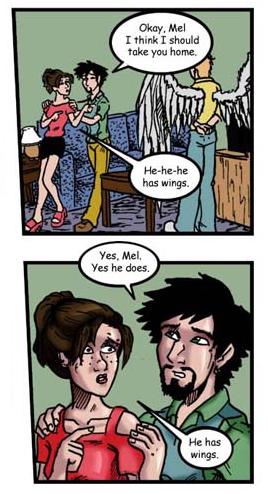 My big discovery from Otakon was Sorcery 101 – though it was less of a discovery and more of a final push. This is a comic I’ve been hearing about for months, and in all the right places. It is one of a very small list of comics of which I’ve had a review requested by someone other than the creator. And, you know – it’s urban fantasy, a genre I always like to see done well.
But it has hovered at the top of my “To Read” list for a while without moving, and it wasn’t until I saw the booth and heard the spiel that I really felt the drive to finally dive in. Doing a bit more research helped, as well – it is a comic dedicated to 3-5 updates a week, keeping an even balance of humor and drama, and having a month long buffer of strips done in advance.
Now, let me tell you – a buffer is Sign Number One that the artist is taking things seriously – or more accurately, preserving a buffer is. A lot of webcomics start out with a ton of strips done in advance, but that ends up translating to them relying on those strips rather than working at keeping the buffer full. The poster-child for the buffer, Schlock Mercenary, stands as a testament to it’s value. So seeing that Sorcery 101 has been able to keep a buffer going – that is has an entire page dedicated to a promise to the reader – really stood out as a good sign.
So, with high hopes, I delved into the archives, and found a good comic. More than that, I found a comic with the potential to be a great comic – though it wasn’t quite there yet.
Sorcery 101 has a lot going in its favor. The best way to describe the setting is as a slightly more upbeat World of Darkness – you have vampires, werewolves, mages, sorcerers, angels and all other sorts of magic types living in a modern society that seems to (mostly) mirror our own. They aren’t exactly common knowledge, but they seem to fit into the world with relative ease, and pretty much every character has something to make them stand out as special.
The characters are really the lifeblood of the strip, and it is generally their interaction and relationships that drive the show. They aren’t always likeable, but they are eminently human – despite their supernatural natures. For all their powers, the fight scenes seem dull compared to the challenge of seeing them teach, work, drink, raise their kids, go shopping, deal with their exes. Each character has their own history – no one stands alone in importance. For all the magic flying about, that gives the whole story a great sense of reality to it.
So does the attention to detail. The world is certainly fleshed out artistically, but it also has a great attention to minutiae. Posters on walls, t-shirts, cars and toys – little features that simply help to ground the world. In one scene, while making small talk, a character mentions a shirt they own; a couple hundred strips later, they show up wearing it. It isn’t pointed out, nor is attention drawn to it, but when you notice that connection, it is another small step in giving this world a sense of solidity.
The strip does, to be fair, have some room for improvement. Art-wise it has come a good way in just the two years it has been running, and promises to keep getting better. Story-wise it isn’t really lacking so much as not excelling, and while some scenes don’t stand out as strongly as they could, most arcs do succeed in blending jokes with character development to reasonably good effect.
But what the strip could really use is an editor. The web brings with it freedom, imagination, and an audience – but there are times when you can definitely feel the lack of someone standing by to catch mistakes before they go live. Reading through the archives, time and time again I ran into typos, poor grammar, or simply stilted dialogue and poorly managed word-bubbles.
It isn’t enough to kill a strip, mind you – merely to disrupt the steady reading. And, to be fair, I may have felt it more than most. As problems go, this is certainly not the hardest to fix – and with good characters and a solid setting, Sorcery 101 has the heart and soul of a great strip already in place.
Polishing and refining the rest of it? It may take some time, but the strip is certainly on the way – and judging by how word of it has been spreading, there are more than a few people eager to watch it make that journey.
And as of a few days ago, now I’m one of them.
 Damn Good Comics