The Best of Livejournal: Get Medieval
Since Comic Genesis is, once again, inaccessible (at least for me), let’s look at a comic hosted on a site not altogether famous for hosting webcomics. The strip in question is Get Medieval, a comic that has managed to be under-the-radar for several years now. In some ways, this is surprising – in others, less so.
Surprising, because it is a cleanly drawn webcomic that updates every day, with clockwork reliability, featuring a perfect blend of humor and plot.
But at the same time, there are two things that are holding it back. First, as mentioned, it’s hosted on livejournal. Don’t get me wrong, the site gets the job done just fine, with archives, a cast page, and general information – but while efficient, it is also somewhat bland, which can be discouraging to those just happening by. Even worse, I get the sense that there is a perception of livejournal-hosted webcomics being at a more amateur level than ones found elsewhere. The issue here isn’t that it is an inferior webpage to other webcomics – but that readers may assume it is regardless of the evidence, and that can be just as big a problem.
The second real hurdle is the opening sequence, as the reader is thrust into the middle of the show without only vague ideas as to who people are or what is going on. Also, while I love the drawing style, it tends to result (especially early on) in everyone looking exactly the same age, which causes further difficulties with distinguishing between the characters. The result? No connection to the characters or their situation, and the start of your story is exactly when you need to reel people in for the long haul.
Of course, if you can get past those two elements, you can really discover what a gem this comic is. Some fifty strips in, the action truly begins, and even more importantly, the original cast gets split up. And while the early strips might have had some difficulty dealing with the half-dozen characters initially crammed together, a long stretch of dealing with no more than two at a time allows the strip – and the characterization – to really begin to shine.

Let’s back up a step and look at the premise of the strip.“Once upon a time, long, long ago in a faraway land, a spaceship landed on Earth.
Its occupants were on the run from the interstellar mafia and looking for a place to lie low for a little while. What they got was this grubby, misogynistic little steel-age world where the beer’s always warm, there are too many eels, and peoples’ idea of fun is watching guys in metal exoskeletons hit each other with sticks.
You take what you can get.”
Now, that’s a good set-up. The space opera and the medieval elements are mixed together surprisingly well, you’ve got a full dose of conflicts right from the start, and a wealth of setting and atmosphere (no pun intended) to draw upon. You have plenty of historical elements that you can either indulge in or gleefully mock, and the strip’s creator, Irony, does both in equal measure.
But at the same time, you might notice that my little summary of the comic’s best qualities, at the start of this post, doesn’t mention the premise or the setting. They are good things, don’t get me wrong – but I feel like you could take the elements of what make the comic great, and transplant them into an entirely different scenario without any loss in quality. The strip has that most important property that screams professionalism – consistency. Regular, reliable updates with crisp (if cartoony) art. A good sense of pacing, and the ability to keep the plot constantly moving despite setting up daily punchlines.
I’ve seen a number of comparisons made between it and Narbonic, and I really can’t deny them. Oh, they are clearly similar on the surface, judging by art-style, update schedule, and format of the strip – but far more important to me is that they move along in a very similar manner, with a similar sense of confidence. On the other hand, Narbonic was a strip that clearly evolved over the course of several years – while Get Medieval has always had a very firm sense of itself, at least once it got past the slightly meandering beginning.
And there is the tragic state of affairs – this is a comic that has very few flaws, but they unfortunately happen to be ones that specifically form obstacles for new readers. Oh, once a reader manages to get a decent way into the archives, they will be hard-pressed to stop reading – but if you can’t get them to that point, the battle is already lost.
I don’t think the battle is lost for Get Medieval, and while it might not have the prominence it deserves, it still has a solid and loyal following. But I think it does stand as a good warning – that presentation and perception can be just as important as the actual quality of the strip itself.
Critical Hit
 Just the other day I watched through The Two Towers, which I had not done for a year or two. Did you know, it is a significantly different experience after having read through DM of the Rings?
For those not in the know, DM of the Rings is a webcomic, of sorts, that attempts to answer the question “What if The Lord of the Rings was a Dungeons and Dragons campaign, populated by some standard stereotypical gamers?”
Hijinks, as you can imagine, ensue.
The comic isn’t drawn, but instead consists of exceptionally well-chosen screen shots from the movies, with appropriate dialogue added. But fair warning given – certain bits of dialogue may be forever altered in your memory, and watching the movies, or even reading the books, may never be the same.
This is a strip that is, in many ways, the king of in-jokes, being based on poking fun at obscure references to D&D rules, or reoccuring trends in roleplaying games, or merely specific cliches that developed from Tolkien’s stories. Some aspects might be funny even if you aren’t a gamer, but there is definitely many jokes that will be hard to get. On the other hand, the fact that they are so specific to certain situations means that if you have been through those circumstances yourself, the jokes hit even more close to home.
Order of the Stick started out on a similar level, admittedly, and certainly proved there is an audience for this – but it also eventually transitioned into a story driven webcomic, which isn’t really an option here. There is a level of plot revolving around the players of the game and their actions and personalities – but it largely has to give way to the plot of the game that the characters are being run through, which it self is merely a delivery mechanism for the jokes.
Still, Shamus Young has been managing to successfully deliver those laughs for well over a hundred strips – and while this is unfortunately a comic with a finite life span, it is one that has managed to do a remarkable job of keeping its initial momentum going strong.
Even with all the other webcomics out there, I can’t really think of any other quite like this one. Irregular Webcomic is the closest that comes to mind, but while it has a lot of similarities, it comes in smaller and more general doses that don’t have the same impact. When DM of the Rings does wrap up, I can already see the void it will leave behind – which is a pretty good sign of a legacy right there.
The Best of Comic Genesis: Manic Graffiti
 While some other comics seem to be having unfortunate server issues, Comic Genesis seems to have regained a measure of stability – making this a good time to start off the second round of CG reviews!
Manic Graffiti is a niche comic. Now, there are plenty of niche comics out there that are entirely accessible to whatever audience stumbles upon them – Unshelved, +EV, even Penny Arcade, can all be enjoyed without having an abiding love for libraries/poker/video games. The reading experience is certainly enhanced by familiarity with the relevant topic, but it is by no means a prerequisite for reading – or enjoying – the strip.
Not so with Manic Graffiti. This is a comic about World of Warcraft – and more than that, about all the little quirks of the game, silly quests and bugged game mechanics, class balance and the hazards of pvp. Now, this still makes for a substantial target audience, considering how many people who have gone through the WoW Experience, and how significantly that playerbase overlaps with the internet population in general. And, admittedly, some of the jokes have a more general appeal – but for every one along those lines, there are two more that require in-depth knowledge of the game and lore to truly appreciate.
This isn’t a bad thing, mind you – especially for a comic being created for the artist’s own amusement. It is a chance to rant about the game and entertain those of like minds. But it is a fact that should be noted. Never played WoW? This comic probably won’t do much for you.
But if you had, it just might make you laugh your ass off.
In-jokes are a wonderful thing, and ones revolving around a game are doubly so. They help create a sense of empathy that not every form of humor has – and in this case, you are laughing about shared experiences with all the foolish pitfalls of a game, usually with you as the victim. More than that, it’s a good sensation to fnd a measure of fun in the various frustrations the game can offer. I hesitate to call it cathartic, but I’m not sure I would be wrong to do so. Those who have played WoW can attest to the perils thereof, and those who have weathered the dreaded end-game know all too well how serious such an activity can become.
Being able to laugh about it? That is an excellent thing.
There are, unfortunately, perils of this humor – as I mentioned before, you are losing a large audience right off the bat, since the jokes are impenetrable to anyone who hasn’t played the game. But even more than that – a game like WoW is constantly evolving and changing. Every single reference you make can easily become outdated, as quests become old and rules are altered. Even people who play in the current moment might not have a clue about the concerns of class balance from two years back.
On the other hand, for those who were around back in the olden days, and recognize the reference at hand, it can even bring a bit of nostalgia, for lack of a better word. And that can help you connect with readers on a much more intrinsic level than most.
The strip is certainly funny, even if some of the laughs might not stand the test of time. The art is, at least in my eyes, extremely well done, even as it bounces between two wildly varying styles. On one hand, you have a set of characters rendered in a relatively detailed fashion, which manages to capture the visuals of the game even while it mocks them. On the other hand, we have the ‘noob-style’ cast, which are depicted in an extremely cartoony, almost super-deformed fashion. Which results in almost appalingly cute characters, but also serves as a great tool for poking fun at the game – and the people that play it.
The art can, unfortunately, be a little busy – drawn in black and white, when done in the more detailed style, it can sometimes be tricky to see where one character ends and another begins. This is largely a problem early in the archives, however – later strips seem mostly devoid of that problem, as the artist learns and improves.
Funny how that happens, ain’t it?
Anyway. It’s a good comic, and more than that, it’s a fun comic. Because really, in a world filled with mutant chicken-deer, mutant turkey-buzzards, and giant multicolored snake-dog-chickens, is there really anything one can do other than to laugh?
Sorcery 101
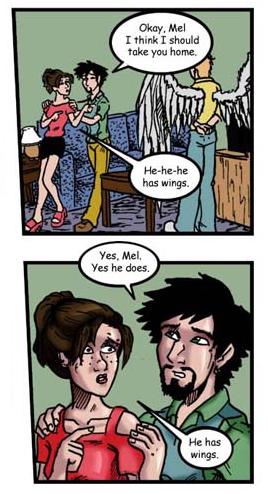 My big discovery from Otakon was Sorcery 101 – though it was less of a discovery and more of a final push. This is a comic I’ve been hearing about for months, and in all the right places. It is one of a very small list of comics of which I’ve had a review requested by someone other than the creator. And, you know – it’s urban fantasy, a genre I always like to see done well.
But it has hovered at the top of my “To Read” list for a while without moving, and it wasn’t until I saw the booth and heard the spiel that I really felt the drive to finally dive in. Doing a bit more research helped, as well – it is a comic dedicated to 3-5 updates a week, keeping an even balance of humor and drama, and having a month long buffer of strips done in advance.
Now, let me tell you – a buffer is Sign Number One that the artist is taking things seriously – or more accurately, preserving a buffer is. A lot of webcomics start out with a ton of strips done in advance, but that ends up translating to them relying on those strips rather than working at keeping the buffer full. The poster-child for the buffer, Schlock Mercenary, stands as a testament to it’s value. So seeing that Sorcery 101 has been able to keep a buffer going – that is has an entire page dedicated to a promise to the reader – really stood out as a good sign.
So, with high hopes, I delved into the archives, and found a good comic. More than that, I found a comic with the potential to be a great comic – though it wasn’t quite there yet.
Sorcery 101 has a lot going in its favor. The best way to describe the setting is as a slightly more upbeat World of Darkness – you have vampires, werewolves, mages, sorcerers, angels and all other sorts of magic types living in a modern society that seems to (mostly) mirror our own. They aren’t exactly common knowledge, but they seem to fit into the world with relative ease, and pretty much every character has something to make them stand out as special.
The characters are really the lifeblood of the strip, and it is generally their interaction and relationships that drive the show. They aren’t always likeable, but they are eminently human – despite their supernatural natures. For all their powers, the fight scenes seem dull compared to the challenge of seeing them teach, work, drink, raise their kids, go shopping, deal with their exes. Each character has their own history – no one stands alone in importance. For all the magic flying about, that gives the whole story a great sense of reality to it.
So does the attention to detail. The world is certainly fleshed out artistically, but it also has a great attention to minutiae. Posters on walls, t-shirts, cars and toys – little features that simply help to ground the world. In one scene, while making small talk, a character mentions a shirt they own; a couple hundred strips later, they show up wearing it. It isn’t pointed out, nor is attention drawn to it, but when you notice that connection, it is another small step in giving this world a sense of solidity.
The strip does, to be fair, have some room for improvement. Art-wise it has come a good way in just the two years it has been running, and promises to keep getting better. Story-wise it isn’t really lacking so much as not excelling, and while some scenes don’t stand out as strongly as they could, most arcs do succeed in blending jokes with character development to reasonably good effect.
But what the strip could really use is an editor. The web brings with it freedom, imagination, and an audience – but there are times when you can definitely feel the lack of someone standing by to catch mistakes before they go live. Reading through the archives, time and time again I ran into typos, poor grammar, or simply stilted dialogue and poorly managed word-bubbles.
It isn’t enough to kill a strip, mind you – merely to disrupt the steady reading. And, to be fair, I may have felt it more than most. As problems go, this is certainly not the hardest to fix – and with good characters and a solid setting, Sorcery 101 has the heart and soul of a great strip already in place.
Polishing and refining the rest of it? It may take some time, but the strip is certainly on the way – and judging by how word of it has been spreading, there are more than a few people eager to watch it make that journey.
And as of a few days ago, now I’m one of them.
The Proper Way to Start the Day
I’m not quite sure how it has come to pass that I haven’t previously mentioned Breakfast of the Gods. It isn’t just that it deserves it – I genuinely remember talking about this strip, at length, on a prior occasion. But searching the archives reveals nothing, so I can only conclude I was merely trying to force it upon my friends in an attempt to ruin their childhood memories.
Breakfast of the Gods is one of those comics that takes a seemingly silly topic and decides to transform into something filled with drama and depth. This isn’t something new – Erfworld does it for turn-based strategy; Cheshire Crossing follows the adventures of Alice, Dorothy and Wendy; and whenever we catch a look at the characters of Something Positive enjoying a round of role-playing, it is usually in a similarly surreal setting.
But even with this evidence, if you had told me a year ago that one could create a powerful and compelling story about the life and death of cereal mascots, I would have called you a goddamn liar.
 Brendan Douglas Jones has put together a world wherein the likes of Captain Crunch and Tony the Tiger stand for honor, courage and loyalty. Count Chocula and his minions torture and murder innocent mascots, and seem to have the lands in an iron grip of despair. The fate of all Cerealia is at stake, and only the mystery of the land’s long-slumbering King might promise the return of a complete and well balanced breakfast…
Wait, why are you laughing? This is serious business, people!
What really impresses me about Breakfast of the Gods is that Jones manages to actually capture a genuine sense of dramatic tension, despite the obviously ludicrous nature of the setting and the cast. He keeps the characters true to form in appearance – the art is perfectly cartoony and brilliantly rendered, which makes it all the more disturbing when the tone grows truly dark. That blend of the silly and the dark is what makes the comic so surreal, but also what makes it so effective.
This isn’t just parody for the sake of parody – though it might have started out as such, it has developed into a genuinely engaging story. Yes, I’m interested in seeing which ancient mascot from the past is brought into the show – but far more than that, I’m eager to see the heroes fight their battles and the mysteries of the Kingdom revealed.
Breakfast of the Gods is another series that wins on sense of style. Jones is able to take the characters from battle on the high seas to noir-style detective drama in a heartbeat, all the while weaving an epic story out of absurd elements. The first chapter, entitled “The Last Good Morning,” is finished – and seriously, is that not an awesome name or what? The title for Chapter Two, “O Cap’n, My Cap’n,” is chosen equally well – and the chapter itself is moving along at a steady pace, after a brief hiatus between the two.
Now’s a great time to dig in – assuming you don’t mind having part of your childhood permanently warped in your mind.
For a story like this, that’s a very small price to pay.
Practically a tradition, at this point.
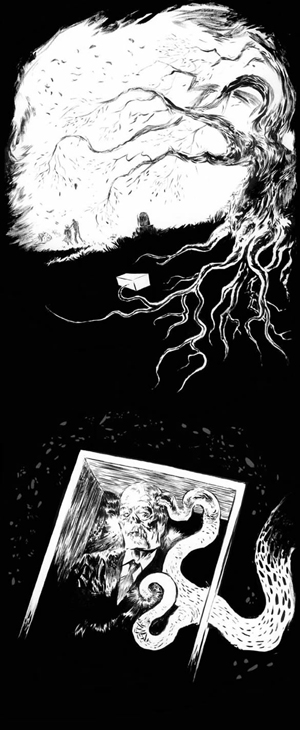 When I was young, my father gave me a number of old comics. I can’t remember most of them, but I do know that, among the tales of brightly colored heroes and fantastic adventures, there were a handful that stood out.
They were horror comics. They had names like Worlds of Terror and Weird Tales – and they were. They were odd, they were strange. They were occasionally vaguely unsatisfying, and they were always unsettling. I did not much care for them – though I read them all. I read most anything I could get my hands on, and so even though I far preferred the superhero tales – where the good guys won, and the endings were always agreeable – I read the Weird Tales nonetheless.
Years later, I don’t remember the slightest about the other comics – but the horror tales stayed with me. Given how terrible my memory normally is, even being able to recall a handful of scenes from those stories is a great feat – and a testament to the fact that, unlike everything else in that collection, they alone left a lasting impression.
But alas – those sort of comics faded away. Public criticism of comics – especially ones with potentially disturbing content – resulted in their departure, and the return of the superhero genre. I imagine you could find similar tales in the underground comic scene, but that would be a challenge, and finding them in modern work is even more difficult – even among webcomics, notorious for delving into any and all genres available.
But that doesn’t mean they aren’t there.
I was told about Split Lip a few months ago, but I only just got around to truly looking at it in depth. It is precisely what I was told it was – a monthly horror webcomic, with a new self-contained story each month, featuring a different artist for each story, all written by Sam Castello. When I finally read it, though, the startling thing was what else it was – it was just like the horror comics I remember reading all those years ago.
Strange. Occasionally unsatisfying. Always unsettling.
Some of the stories are psychological thrillers, some feature more supernatural horrors. With others, the line between the two is entirely unclear. Sometimes the endings are outright horrible – with others, merely bizarre. But they all manage to hit that punch of strangeness and terror, just enough to send a little chill running up the spine.
Costello writes in just the right tone to keep the reader off balance. He manages to track down artists from all over the world, each with their own style – but always a style that fits the story perfectly. Always a style that captures the almost surreal imagery infusing the story.
Surreal and disturbing, yet filled with curious and creative ideas – perhaps that is really what defines this brand of comic. Having clever concepts that draw you in, even as they are unsettling enough to push you away. It isn’t about outright scaring the reader – it’s about trapping them in that state between repulsion and interest. In fact, there’s something of a horror story in that concept alone, isn’t there?
Costello and his cohorts certainly get it right, story after story, month after month.
The Third Friday the 13th Webcomic Horror Award goes to Split Lip, without a shadow of a doubt.
Nothing Reckless About It
You know, it wasn’t until yesterday’s update that I realized quite how much I was enjoying the recent Reckless Life storyline.
Now, I’ve enjoyed Reckless Life for a long time. It wasn’t one of the strips that convinced me to subscribe to the Graphic Smash collection – Fans! and Digger did that – but it was the biggest discovery that subscription rewarded me with. It’s something of a crime that, while I’ve mentioned it in passing a time or two, I’ve never given it a proper review. In my defense, it was on a subscription site, and I tried to avoid directing people towards content that wasn’t freely available; but Graphic Smash has since moved away from that model, and the archives of Reckless Life are now open to all.
Given that I no longer have any excuse for discussing the strip, let’s get started on fixing my mistake.
Reckless Life is, in short, one of the most professional comics on the web. Everything about it seems to fit perfectly into place. Visually, the strip is consistently a pleasure to look upon – and more than that, feels pretty much artistically flawless. I am a fan of a great many webcomics that are still coming into their own – and there isn’t anything wrong with that. But as much as I enjoy seeing an artist develop over the course of a strip, Tim Demeter stands out as someone who has already mastered their own style. The world of Reckless Life makes brilliant use of contrasts and shadow, drawing from a palette of black and white, greys and reds. It makes for a cinematically powerful setting, and while it doesn’t sink in tone quite to the grim level of Sin City, a similar sense of stark simplicity is still there.
The stories are similarly well-executed. Tim hits a very careful pace between humor and drama – if one storyline deals with personal relationships, the next will be about ninjas. It all seems very carefully planned out – but the formula at the heart of it doesn’t prevent the stories from all working exceptionally well. Another nice touch is that each storyline is almost entirely self-contained. The strip does grow into a more complete world as it goes on, but it is not at the beck and call of a single over-arching plot. While new characters might be introduced who become recurring characters, and our hero, Locke, each episode is still able to easily stand on its own.
And rest assured, the characters who start to populate the strip are good ones. While fundamentally they may seem iconic – the hot-headed thief, the cold-blooded hit man, etc – they manage to develop into interesting characters. The credit for that goes to Tim’s sense of style – the characters stand out as more than merely stereotypes, and being visually dynamic manages to help make them into genuinely engaging individuals.

Let’s take a look at the star of the show: Locke. Master thief, gambler, joker, he’s just as good as he thinks he is – capable of dodging bullets and breaking through the best security in the world. Yet somehow, despite his skills, his relationships constantly fall apart, he doesn’t have friends so much as acquaintances, he lives in the ruins of Old Vegas, and manages to end in jail as often as not.
Locke is a fun character – he is able to do feats of incredible skill, and walks and talks like someone out of a movie… but the degree to which life seems to fall apart on him makes him exceptionally human. He’s the hero of the story, but he isn’t a good guy – not really. He has lived a life that has taught him that the only way to survive is to look out for number one, and while he doesn’t rub that philosophy in the reader’s face, you can see it in everything he does.
He has his good qualities, and would probably even be a nice guy if the world had dealt him a better hand. He’s surprisingly loyal to those he would call friends – even when they’ve betrayed him. He’s still willing to kill, hurt and steal if that’s what it takes – but in a world of corruption and crime, he compares favorably. He’s not a good guy – but he’s better than most, and that’s enough.
Which brings us to the latest storyline, where we learn what made him this way. After perhaps the most absurd story yet – the tale of how Locke Saves Christmas, complete with Santa, sleighs, and singalongs – we moved into the grim and gritty world of Locke’s past… as an emo kid in highschool.
The comic remains true to form, and takes a concept that could be cliche, and instead makes it work. In some ways, it is hard to picture Locke as the kid he is, living a life in suburbia.. but it also seems strangely fitting. And we can see it all begins here, as his life starts to go downhill, step by step – the title of the arc is Murphy’s Law, and you’ve got three guesses as to why.
It isn’t that Locke has the worst life in the world. He doesn’t. He’s had some hard breaks, yes, but in many ways it is his own nature as much as his circumstances that continually leads him down, step by step. But that doesn’t make him not sympathetic – in many ways, it makes him more so. He’s human – we can relate to that.
This week’s update shows Locke standing outside as it starts to snow. His friends and family are gone and left behind. He’s dropped out of school, been fired from every job, and sold his most valuable possessions for a handful of cash – and has been evicted anywhere. He has no home. He has no one. And here he is, standing in the snow.
It’s a powerful moment, but Mr. Demeter manages to do it justice. He’s had practice with scenes that lack any dialogue, but most of those are action sequences – much easier to pull off.
I’ve been enjoying the recent arc, but this was the moment that really grabbed my interest. Because we know how the story ends, in a way – we know who Locke becomes. We know that he does manage to improve his lot – and even if he doesn’t end up with the perfect life, it is still a far site better than this. We’ve even seen, quite early in the series, that he is able to find at least some degree of peace with part of his past.
But we haven’t seen how he gets there – and that is the story I think is about to start, and one I am definitely eager to see.
The Saturday Morning Blues
I was not going to write about a comic today.
Other things on the mind, you know. No real comics currently on the brain. It’s a gorgeous day outside.
I had plenty of reasons to put webcomics aside for a day… and then I was sent a link to Planet Saturday.
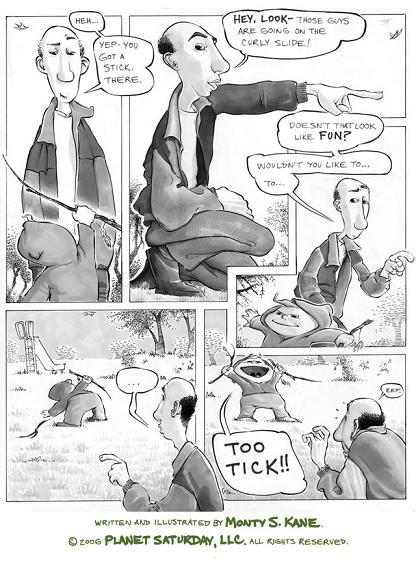 According to the site, Planet Saturday, by Monty S. Kane, is “a monthly comic about memory, imagination, and parenthood.” It is “GUARANTEED, in no particularly legally binding way, to amuse, educate, and enlighten; remove unsightly blemishes; grow hair on bald heads; and make you taller. The comics, in particular, will cut through a soup can- and still slice a tomato LIKE THIS!”
A guarantee that seems to have been delivered in full.
These strips are not going to blow you out of your shoes, mind you. You will not be rolling on the ground in laughter. You will not be biting your nails in anticipation of momentous plot twists or action-filled space battles. You will not be seized by an onslaught of emotion, energy and exuberance.
But it just may be you will feel something much more subtle take hold. These comics may bring forth a more internal appreciation, and a recognition of some of the simple glories in everyday life, in childhood, in family. I suspect they will make you think – and I would lay odds that they will make you smile.
Planet Saturday Comics are short little vignettes about life and the living of it. Memories, growth, hopes, dreams, and the myriad little things that make up the world. Cute, and simple, and heartwarming – in many ways, this resembles Calvin and Hobbes as told from an adult’s point of view.
The comic is just over a year old. There are thirteen episodes in the archives, ranging from two to nine pages each. It will not take any great measure of time to read through them all – but I would consider it time well spent.
This sequence, in particular, is a tale particularly well told.
The art is crisp and clean, and deserves an entire post of its own discussing how gorgeous it is. The stories are well-written, short as they may be. The concepts within are sound and sincere.
This, my friends, is a damn good comic.
The Best of Drunk Duck: Culture Shock
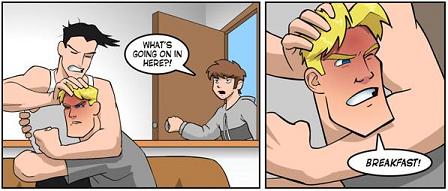 A knight from the fourteenth century and a japanese ninja arrive in the big city and end up working together for a computer hacking gangster crimelord.
Hilarity ensues.
Culture Shock is really just a comic that is just good clean fun. There really isn’t much than that I can say!
The art is bright and clean and nicely shaded. The characters – who range from the trio mentioned above to well-meaning cops and innocent elven mages – are not incredibly deep individuals, but this doesn’t stop them from being all remarkably likeable. And as much as each might be built from a very simple idea, they each have moments where something more shines through.
Also: Most awesome cast page I’ve ever seen.
Sometimes you don’t need complicated plots or earth-shattering drama to make a good comic. Producing something nice to look at, with a sense of style and a likeable cast, can be all it takes to win an audience over.
There aren’t any superheroes in this comic. But in a day and age when Marvel and DC are busy killing, raping and maiming characters in every blockbuster event, just to get some attention, coming across a comic that remembers what it’s like to just tell a fun story… well, it’s a breath of fresh air.
It’s what comics is really all about.
The Best of Drunk Duck: Hero by Night
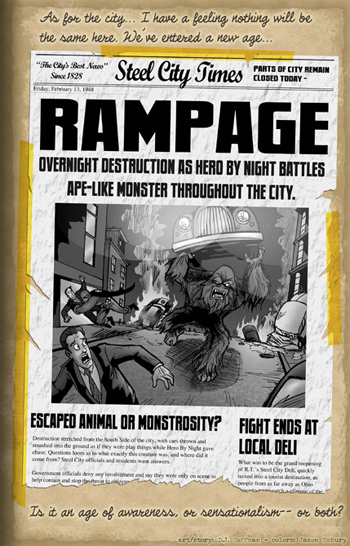 I was never the biggest fan of Yirmumah. This was in part because DJ was at the height of his trouble-making days, and actively causing grief high and low across the internet – but it was also ’cause I didn’t really like the comic. It just wasn’t my type of humor.
So when DJ started up Hero by Night – especially with Yirmumah having taken a turn down some genuinely decent sequences – I decided to check it out. I found the name itself a little silly, but DJ had shown some flare for a good dramatic story, and I was interested in seeing what he could put together.
While the comic itself was being released in stores, the Hero by Night Journals were being posted online, telling the tale of the original Hero by Night. I enjoyed the diaries and their format – they were essentially snapshots in time rather than fully fleshed out tales, and it was an interested format for presenting a character. At the same time… it didn’t really compel me to go out and buy the series. The character was enjoyable, but didn’t feel more compelling than any standard comic icons – it felt like just another superhero.
There wasn’t anything wrong with that – but it wasn’t groundbreaking as some seemed to be saying. Every few weeks I stopped by to catch up on the diaries, but that was it.
Then DJ started posting the Hero by Night comic itself. The story of a young kid who finds the magic ring the once belonged to the first Hero by Night, and deals with the consequences thereof. And… it was great! It was fun and exciting, and I couldn’t stop reading. It still didn’t feel like it was anything new – but it was compelling enough to make me eager for every update.
I credit the journals themselves for much of this. One of the greatest strengths of print comics is the sheer amount of background the characters have – the momentum they have developed over the years, with supervillains and sidekicks, triumphs and defeats, personal discoveries and growth. It lends them weight and impact – when done right. Unfortunately, that background is also one of their greatest weaknesses, as they threaten to topple from the burden of conflicting origins and different writers and the need to keep them locked in a perpetual stasis while they can still adapt to – and reflect – modern culture.
With the Hero by Night Journals, DJ managed to capture that same sense of background and history, all neatly defined and delineated. Neither the journals nor the comic were able to grab me independantly – one was the shadow of an already finished tale, the story of a hero whose time had already ended, while the other was no different than countless other comics, with a kid finding a magic widget and blundering into superpowers. But together they formed something more than the sum of their parts – a story with a firm sense of past and present, which manages to keep the reader all the more interested in the comic’s future.
Even though I could simply sit back and wait for Hero by Night to be released online, an issue behind the comics coming out in stores, DJ has finally managed to amp up the tension – and my investment into the strip – that I’m left interested enough to buy it if I see it in the comic shop.
I’d say that’s one form of webcomic success in action.
 Damn Good Comics