Zombies, Mark 2
Updates for next week may be scarce, as I’ll be moving this weekend. For now, I’ll leave you with a few final zombie reviews, and hopefully will be back as soon as can be!
 First up, The Zombie Hunters, which I first heard about by way of the Ferrett. He is a fellow who likes zombie movies, and this makes him a hell of a lot better prepared to talk about this sort of things than myself, and his review of the strip covers things well.
So, instead, I’m going to focus on the opening pages of the comic. Specifically, the first twenty pages, which manage to feel like they were straight out of a movie, wherein the pages alternate between a few moments in time – glimpses of the characters the story is about, as they wander through this apparently deserted town, clearly ready for danger – and stark credits of the strip’s creators and contributors, white text on a black background. The tension keeps rising and rising, until the zombies pop up, we hit the title page, and it launches out into the action, and the energy just doesn’t stop.
I’m impressed by this. Really impressed. It would be very, very easy to employ a set-up like this and have it feel forced, or frustrating. But the sense of pacing in this strip is fantastic, and we instead have me feeling a rising sense of drama through the first handful of pages, instantly pulling me in. And if it can do that in the opening sequence alone, that is awfully promising for whatever else may come.
Next up, Little Terrors. The premise is a nice one – zombies and other horrors appear to have mostly wiped out humanity (at least in the area in which the story takes place.) Our protagonist, Jacob, is a young boy who has woken up, pretty much without any memories, and discovered that despite looking similar to the zombies, he isn’t like them. He then runs into a pack of other young kids, all of whom have found themselves similarly changed into iconic monsters – with a werewolf, cyclops, frankenstein, ghost, etc.
There is an element of humor to the situation, but it seems to be a drama at its heart – and one that is really starting to come into its own. The art has vastly improved since the story began, which is easy to notice – but all the other elements have begun to come together as well, with a smoother layout, more elaborate plot, and more concise writing.
 Finally, I was prowling the Wotch’s totally awesome links page, and came across Dead Winter. The strip currently only has twenty-six pages to its name, but that doesn’t stop it from winning me over. Hell, it did so in under ten.
I blame the cast, who are pretty much all instantly awesome, from our hero Lizzie and her lovable attitude (along with her complete inability to notice when she is surrounded by zombies), to the altogether badass individual known as Black Monday Blues.
Also, the art, which is amazing and vibrant and alive. (Unlike the zombies.)
Perhaps the story as well, as I’m already interested in finding out how her boyfriend knew about the zombie invasion, why he has to leave her behind, and what will happen when she inevitably kicks ass, survives the zombies, and confronts him over his dastardly behavior.
Aw, hell, just go take a look.
The Best of Drunk Duck: The Gods of Arr-Kelaan
I’ve been sent more than a few links to quality comics hosted on Comic Genesis, and I’ve spotted a few good ones in thi’s years Comic Genesis Free Comic Book – but it will take some time to truly soak them in. So while I let my thoughts on them simmer, it seemed a good idea to switch focus for a few weeks to some of my favorite strips from another hosting site – Drunk Duck, which has been working hard at overcoming its previous less-than-professional reputation.
I don’t have much experience with Drunk Duck in the past, so I can’t say much about the state it was previously in. These days the site design is functional, if somewhat cluttered, and it seems much easier to search through the various hosted comics than it was even a few months ago.
What I do know is that, while there certainly seems a plethora of more amateur work on the site, it also has some real winners.
 The Gods of Arr-Kelaan, by Chuck Rowles, is easily at the top of the list.
First, though, let’s talk about Dungeons and Dragons. One of many roleplaying games, D&D is often thought of as the king of the Hack and Slash genre – it is about looting monsters, levelling up, and fast-forwarding past the roleplaying part itself. To be fair, there are plenty of games along those lines – and there are plenty of times when just rolling the dice and chopping off an orc’s head is simply great mindless fun.
Even in more serious games with a much more dynamic plot, the thrill of combat has its place. But for all its focus on it, D&D certainly has the capability to be a game that indulges in story and depth. Regardless of the system at hand, that decision is one that comes down to the players – and to whomever is running the game.
I like running games. I am preparing to start one back up after several years on the sidelines, and I am remembering what is possibly my favorite part of the entire process – designing the setting. Developing an entire world, from creation myth to societal trends, from the rise and fall of past civilizations to the current dungeons and plot threads of the modern day.
I tend to think big, in terms of such things. It is both a strength and a weakness in many ways, and one felt just as much in my writing as in my games. It has one other added benefit – The Gods of Arr-Kelaan is able to win me over on the premise alone.
The main focus of the story is on a group of deities of Arr-Kelaan – ones who were, not all that long ago, ordinary people from Earth. Through mysterious circumstances, they end up on this strange new world with incredible powers, and find themselves settling into specific roles that fit their various personalities. Conflicts arise between them – and between other gods as well, including familiar deities from Norse, Greek, and Incan pantheons, all of whom have also found themselves on Arr-Kelaan.
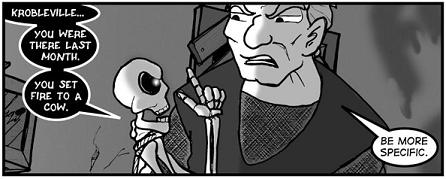 One would think that such dealings would result in epic storylines, as vast and incomprehensible powers are thrown about – and that does happen from time to time, sure. But the real focus of the series is on the humanity of the gods and their worshippers. Exploring how mortals deal with ascending to divinity, how they interpret their power and responsibilities in different ways, and the goals and motivations that drive them.
The story starts with the star of the show, Ronson, waking up in this strange new land and slowly discovering the powers at his fingertips. Unfortunately the rest of that part of the story isn’t online (though it is available in print.)
From there, we leave Ronson for a bit, as we get a look at some of the heroes of the land – with a number of shorter tales mixed in, introducing us to the various gods that have started to populate the land. While not central to the main plot that begins to develop (and, in fact, set a significant amount of time in the future of the main plot), these stories do a great job of fleshing out the characters and the setting.
And after that… well, that’s when we get into the meat of the story, as we see Ronson learning to accept his new-found divinity, even as he searches for a way home. We learn how even gods can be haunted by the ghosts of the past – and the puzzle of how he and his brethren ended up on Arr-Kelaan all begins to come together.

The story is not just about him, of course. There is a whole slew of gods and followers and even the occasional oracle. Seeing them all interact – seeing them change, and seeing the changes they leave across the world – is a very interesting thing, indeed. It makes for a good story, certainly – and leaves plenty of room for humor, of course. Don’t let the epic nature of what is going on make you think otherwise – seeing these ordinary people given control over life and death is a recipe for all sorts of hijinks, and Rowles easily keeps the tone light and fun.
But even while he does so, there is a bigger story building up. The creation of a pantheon. That is a big deal, make no mistake – and lately, the stakes have been only getting higher. Ronson’s quest for the ghost of his wife – which has been his greatest focus since the series began – has finally yielded fruit… and a much more dangerous enemy than imaginable.
And from there… well, I suppose you’ll just have to find out for yourself.
The Best of Comic Genesis: The Prime of Ambition
 The Prime of Ambition is a fantasy comic, which is usually a sign that a strip will be walking down a well-worn path that many have trod before, telling the same stories that have been told countless times before. This would not be a bad thing, for those stories are still good stories after all these years – but that is not what Ambition is about.
The Prime of Ambition is about telling a new story.
The Prime of Ambition is about defying expectations.
Our story begins with four young heroes on the brink of battle. They have come upon a dastardly sight – several soldiers of a corrupt nation are sacrificing an innocent maiden to a dragon. They know it will not be an easy fight, but they cannot simply stand and watch. With faith in the righteousness of their cause and their god, they charge into battle.
In a single panel they are slaughtered by a half-dozen unnamed soldiers.
They are not the heroes of the story. The two of them that survive are taken captive, and they serve one purpose – as a vehicle to open the story, and begin a tale that I expect will have many unexpected twists along the way.
Ambition, despite having its own story to tell, manages to stay strong on one of the greatest assets of the fantasy story – the setting. Not just its nature, but the fact that one has an entire world to play in and develop, a world of different races and cultures and societies, different lands and different rules. Ambition is set in the world of Oris, and one is able to get a sense for the detail of the setting from every distinct individual and place. The site also includes a guide to the world as well, so one can see it fleshed out outside of the story itself – which is a good thing, as attention to detail carries with it one fatal flaw, the deadly beast known as exposition.
The story is narrated by an elf named Audriel Sillendrey, a figure whose world-view has clearly been changed by the story he is about to tell us. First person narration isn’t a bad format, and is able to give us some insight into his character while leaving the mystery of other characters open. Unfortunately it also means he spends a lot of time – especially early on – explaining and introducing.
It is a necessary evil, in the end, and one made more tolerable by the art that accompanies it – each page is full color and filled with detail, bringing the world to life with every panel. In some ways it is a shame when such gorgeous artwork is cluttered up with text – but like I said, necessary evil. You can’t tell a story without setting the scene, and if the artwork is engaging when in the midst of exposition, it promises to be mind-blowing once the action gets going.
There are less than 60 pages in the archives, and the strip updates once a week, so perhaps its greatest downside is a tendency towards a slower pace – especially given the early part of the story is focused on character development over action. Whether that is good or bad, of course, depends on the characters, and – fortunately for us – that is where Ambition really shines.
As mentioned earlier, the story is told by Audriel, a sun elf – but he is not the star of the show. There are a couple other characters of note, but the main focus of the story is a drow named Thanatos. And Than… well, Than is somewhat complicated to explain.
The narrator, Audriel, hates him – hates all drow passionately due to his own personal tragedy, in fact. So we have to balance his view – that all drow are evil – with Than’s own actions, which tend to present him as a tragic figure trying to make amends for his people.
Now, if that was it, then this would be just another story told many times before. He wouldn’t be just another Drizzt, sure – no dual scimitars, no magic cat figurine, and the people he comes from are an entirely different type of drow; but it would still be falling into the stereotype of the outcast who has to prove himself against a society that distrusts him. Which wouldn’t make it a bad story, but it also wouldn’t be anything new, just the same tension seen – and overcome – countless times in the past.
But as far as I can tell, Ambition takes it a step further – because I get the sense that Than’s kind nature and behavior is all just an act.
I could be wrong. I suspect there is a lot more to it than any simple explanation might give – but there have been enough subtle clues that this apparently kind drow is fully manipulating those around him. That he has an agenda and motives well beyond what has been revealed thus far, and that learning more about that – and about him – is when the story will really start to get moving. He may not be evil, but the way he seems to act and move and speak strike me as those of a character who may well be amoral – who acts according to their own views, not through limits set upon them by society. And that makes for an interesting character indeed.
Of course… this is just my interpretation of the story and the character. Ambition is only in the second chapter, and it could easily have been an overly hasty judgement. As I said – I could be wrong. Who knows where the story could go from here?
But having those questions, and finding out the answers, is the mark of a good comic. Engaging that interest and curiosity is the sign of a good story. And as to whether my theories turn out right or wrong in the end… wouldn’t it be best to go and find out for yourself?
Full Comprehension is Overrated
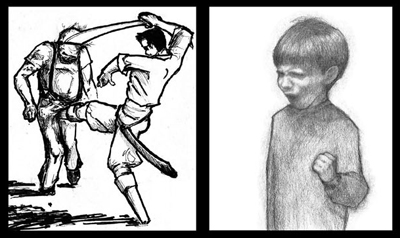 With nothing too exciting happening in my normal strips – other than the usual awesome comics continuing to be awesome – today seemed a good occasion to take a look at a comic I was recently sent to review that managed to leave me confused, taken aback, and most importantly… fascinated.
That comic is A Fine Example.
This comic is not one that lends itself to easy description. There are characters, yes. There is a story, or at least a series of loosely connected events. There is humor, certainly, though it is less in the form of punchlines and more in the form of surreal absurdity.
I could try to describe it by saying that the main character is John Stiles, an incredibly wealthy pirate with two peg legs and a fake eyepatch, and that he is just as likely to be confronted by a difficulty in emotionally connecting to his son as to find himself fighting off hordes of zombies that have manifested on his front lawn.
I could say that, and it would convey that the strip involves strange characters and bizarre circumstances, but it really wouldn’t capture the true experience of it all.
And that is a good thing, in many ways – to be indescribable. To be that extraordinary.
A Fine Example is the sort of comic that is a fun read, if also one that requires a slight stretching of one’s mind to wrap your head around it. It works, largely, through the art – the style itself varies, with different characters being drawn in completely different fashions, creating what proves to be a rather brilliant internal dichotomy.
And, of course, the story itself wanders all over, from the rather silly, such as his pet… (mutant? robot? I’ve honestly got no idea what the thing is) – anyway, it might be about his pet being pulled over for speeding, causing an unfortunate run-in with the police… or the strip might show his son weaving a careful war of psychological sabotage against Stiles’ girlfriend. (The mother died on a space shuttle a year ago.)
It is unpredictable, and I’d use the term zany if that wouldn’t be a disservice to the dark humor underlying every strip.
It’s A Fine Example. Of what, I’m still not quite sure, but I’m certainly planning on sticking around until I find out.
Zap!
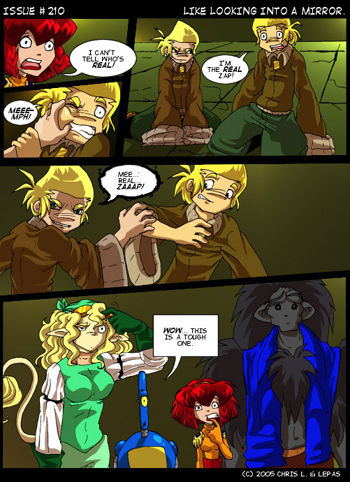 Reviewing Indavo earlier this week reminded me of another strip I’ve been wanting to talk about – Zap!
I was, in fact, surprised to realize I hadn’t already done so, as it had been one of the very first strips I had wanted to discuss – but somehow it slipped through the cracks, and after over a year at this, I never found the time to discuss it.
So let’s fix that, shall we?
With the majority of webcomics out there, one can clearly see the evolution of art and writing over the course of the strip, thanks to the wonders of easy archiving. It isn’t a surprise – the task of working on the strip alone will usually force one to reach new levels, and that doesn’t at all account for development outside of the strip itself – especially as college students, from what I’ve seen, make up a significant portion of webcomic producers.
Zap! certainly follows this trend, though it takes it to a different degree – it evolves early, and the art goes from effective to downright breathtaking. I mention this because I clearly recall how I found the comic, and it was entirely via the art. With most strips, I find my way via word of mouth or hype from a trusted source – in this case, I simply saw an advertisement with a picture of the cast, and bam! I was sold.
Zap may be one of the few comics where, as much as I enjoy the story, it’s the art that keeps me coming back day after day.
Which is not to say the story is bad – far from it! It has some weaknesses – it is often a bit too predictable and a bit too cliche – but that is part of what makes it great. It feels like a classic science fiction tale, and manages to cover all sorts of ground, from politics to mysteries to space battles. It takes advantage of being a scifi strip to actually bring all sorts of clever characters into the picture, and does a good job of establishing interest in not just the good guys, but the villains, too.
Right now is a great time to join in. For one, Volume One of the strip is now available for pre-order, complete with a contest for all sorts of special goodies. Even more importantly, though, the strip is really entering into the big stakes. Our hero, the almost-heroic Zap Vexler, is coming closer and closer to finally uncovering the secret of his past. The woman he loves, Reona, is coming face to face with darkness out of her own past. We’ve got intense action sequences hand in hand with heavy drama, with each strip leaving the audience wanting more. Cliffhangers might be cruel – but they are also a sign that something is going on that’s good enough to keep a reader interested and attached.
Indavo and Zap are very similar webcomics, but with a few key differences. In Indavo, so much of the story is about the heroes exploring the universe and uncovering evil schemes. It is all about exploration and discovery of the world around them, and proving themselves against it. With Zap, it is a much more personal journey, and the exploration and discovery is very often internal. The heroes themselves are still in transition, and still struggling to become who they need to be to save the day.
Both make for great stories, and seeing the differences between the two makes me appreciate each one all the more.
The Midnight Blogger What Blogs at Midnight
 I’ve talked about Indavo before.
It was one of my first posts on this site, actually – and it was a hell of a time to talk about the comic, with a storyline that is still a blast to read through. Of course, the best place to start is at the beginning, and that’s true now more than ever. With my current focus on Comic Genesis strips that really step things up to the next level – and with the supreme awesomeness currently dominating the strip – now seemed the perfect time for a full-blown review of Freelance Explorer Indavo!
Let’s start with some general discussion about the comic. The description I gave it last time – “good solid fun” – still holds true. This is a strip that absolutely epitomizes the quest for adventure as our heroes travel from one bit of trouble to another – righting wrongs, saving worlds, and fighting more bad guys than you can shake a stick at.
It isn’t surprising that the storyline is never dull, but what is suprising is realizing that it isn’t just one random battle after another. We learn important things about our heroes. They learn important things about themselves. And the big picture slowly – ever so slowly – starts to come into focus.
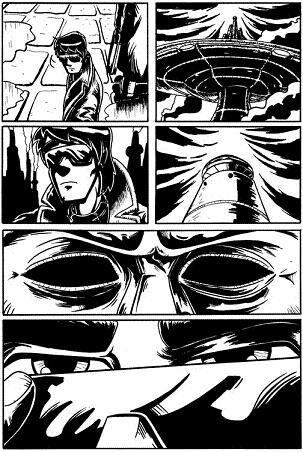
The strip has currently reached a momentous point. We’re coming face to face with showdowns the strip has been building up to since it began. The latest arc abruptly shifted from its classic style into stark noir tones, and once again I found myself surprised by how far the artist, one Nathan Bonner, is willing to push his skills into new directions.
At its heart, the strip has all the things that draw me in. Updates come at a solid pace – three times a week – and are almost never missed. The archives are simple and straightforward, with both dates and storylines available for easy browsing. The cast page and FAQ are extremely well fleshed out, kept up to date, and include a sizable run-down of what has happened in the comic thus far.
But all of that – it’s good stuff, don’t get me wrong, but it is what makes a comic professional, not what makes a comic good. It is certainly possible to be one without the other – there are a couple of comics I read that have stuck with me simply due to reliability, rather than because they do anything to actually engage my interest. But Indavo ain’t one of them.
The art is easy on the eyes, and that’s always a good thing. Art won’t make the story good, sure – but it really defines how well a good story can take hold, and the art for Indavo fits the story perfectly. I mentioned earlier that Bonner really pushes his skills in new directions, and its true – for all that most of the strip has an old school comic book feel to it, there are more and more moments that go a step – or two, or three – beyond that.
What really does it is that the art in this strip has a masterful sense of style. You see it in the character designs – the Time Traveler in the Big Hat remains my personal favorite, but most of the cast and crew have the right attention to detail to make them uniquely alive. Little details and themes throughout the chapters – such as the noir style rendition of In His Immortal Name – shift the mood to suite the plot at hand. The cover pages for each chapter, while seemingly ordinary at first, not only set the mood for each individual arc, but also evoke a connection throughout the entire story as a whole.
And, of course, it’s a good story. There are a lot of strips that move from small struggles to epic battles, but Indavo is one of the ones that does it right. From the beginning the steps are laid to build up the story, but carefully enough they never feel obtrusive. When the inevitable payload comes along, it feels like a perfectly natural result of all that came before it, and let me tell you – that takes some doing.
I don’t know if we’re approaching the end of the run – the stakes are big enough, sure. But even with everything at hand… Indavo feels like something that could go on forever, our merry trio of explorers wandering the universe from now till the end of time.
I have always been a fantasy fan, first and foremost. Science fiction – I read it, sure, but as often as not because it was lumped into the same section as the books I loved. I won’t say I don’t enjoy it, but it takes a really amazing work to truly get me invested in the story.
Indavo is one such strip. A damn good comic that captures the sense of excitement and adventure offered by a universe of endless possibilities. There’s an epic tale there, but not one that loses sight of the little things, and that makes all the difference.
Through the Looking Glass
 My time today has a good number of things vying for attention, so the post today will be short; this is a shame, as there are some recent events in quite a few webcomics that deserve some serious discussion.
Rather than try talk about them and fail to do them justice, I thought today would be a good point to mention a recent comic I was sent to review, a little comic called Fish Tank.
Fish Tank was described to me as a comic about three intelligent fish living in a home aquarium, and their exploits. This didn’t seem like a bad idea for a comic, but my first though was that while it sounded clever, it also sounded incredibly boring.
Even outside of the adventures they go on – taking them from the amazon to Alaska to outer space, the characters themselves are really dynamic, and really alive. Part of it is that they are unique – Ted is a brilliant goldfish with a gift for invention, Angelo is an extremely vain but friendly angelfish, and Hoover is a bottom-feeder who always puts his own interests first. But a lot of it is the way they are drawn. The design of the fish is simple, and feels like a very old school style of drawing – a few loose, flowing strokes that come together to create a complete image.
But the simplicity works wonders where a more complex design would have rendered them completely lifeless.
Fish Tank is a fun strip, and it is a clever one, too. But it proves to be a whole lot more than that, and that’s what really makes it great.
The Best of Comic Genesis: Rêveillerie
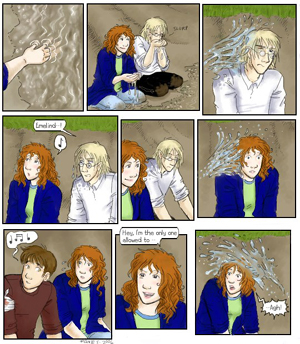 Rêveillerie is a fairy tale, but not in the way you think.
It starts in an entirely ordinary fashion, with an altogether ordinary looking young girl, lost in the streets of what could be a perfectly normal city. By the second page, that illusion is dispelled – this world may be similar to our own in many ways, but magic is a part of everyday life in Tamhaile, and that’s all the difference it needs. The first people we meet, aside from our protagonist Emilind, are denizens of an only slightly unusual library – but are undeniably strange and elfin.
Of course, Emilind herself is far stranger.
Rêveillerie does a lot of things that have really won me over. The storybook feel is one of them – and something that is the product of far more than merely being set in a world of magic and fae. Little details lend it an almost classical weight – for example, the use of small pieces of text that feel like excerpts from an old-fashioned story. Sometimes these little lines fill in small pieces of background, sometimes they set the scene, sometime they give insights into a character’s mind… but all in all, they give the comic a sense of being grounded in more than merely pretty pictures.
Like any good fairy tale, Rêveillerie is built around a sense of mystery. Emelind is on a quest… though we don’t quite know why, or what she is truly looking for. We know a bit about her past, but not how it all connects, and certainly not what makes her so seemingly special in this strange world.
And as with any good mystery, with every answer we get, only more questions arise.
Rêveillerie has its moments of action, but at heart is a character driven story. Each member of the cast definitely plays their own role, and even the characters that are around only briefly still have enough personality to feel real.
Including Emelind herself, whose status as the hero of the story is slightly undermined by her vast self-centeredness. She treats other characters as… no more than tools, in many ways. They are useful to her if they will help her in her quest. She can’t trust anyone but herself. The opinions of others don’t matter to her, and she has a certain ruthlessness that indicates she’ll do what she has to to get her own way.
Oh, she acts pleasant most of the time, and when she does mistreat others, she seems to feel it was almost accidental – but that attitude is still there, and it is part of what really brings the story to life. Heroes are, after all, defined by their flaws. Hers are very real – and justified, certainly, by the fact that she was abandoned into a world that wasn’t her own, and the sense of betrayal that brings. It is easy to understand why she is the way she is – and again, thats the difference between a character a reader can be invested in, and a simple image on a page.
Not that the images on the page are bad, of course. The art is well put together, with soft colors that fit the mood of the tale pretty much spot-on.
The comic’s only real weakness, like with many on Comic Genesis, is that updates are intermittent. It isn’t any surprise – artists have lives, and work, and school, and making comics often has to take backseat to more pressing matters.
But that doesn’t make the strips themselves any weaker, and Rêveillerie has kept itself going for quite a few years now. Here’s hoping for plenty more to come.
The Best of Comic Genesis: The Wings of Change
Have you ever had a comic that is so good it’s frustrating?
For me, it’s The Wings of Change. It’s a strip that has been around for some time now – over half a decade, in fact. I’ve been there with it throughout that entire run, as it began during the Great Framed Escape of ’01 – and let me tell you, that brings back memories.
So it was, drawn by their part in the crossover, that I was there for the first strip of the comic’s actual story. It’s a damn good start, too – we get dropped right into quite a bit of action, in an exciting and clearly fleshed out world with several interesting characters – a dour minidragon who happens to be a ranger, a young (and winged) half-elf who wants to be a ranger, and a sentient unseen tree-being with a somewhat vicious sense of humor.
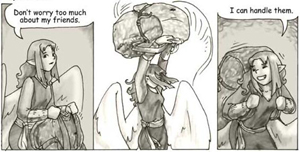 The strip immediately sets itself up as a fantasy style adventure with a solid emphasis on light-hearted jokes, as our protagonists start out trying to convince an extremely senile elder dragon that he should take on a human form when in human lands, rather than wandering about in his normal massive form and inadvertantly causing a war. Various hijinks ensue, they eventually manage to make him change…
…and his human form promptly falls from the sky onto a pixy house, killing the parents and leaving a half-dozen children instantly orphaned.
It’s a rather shocking transition – but not quite as shocking as the fact that the story doesn’t let this change the tone of the strip. The kids recover, Mitch and Hazel argue over who has to become their caretaker, and life moves on. To the strip’s credit, it manages to make this work almost flawlessly, and the reader finds themselves forgetting the awful incident almost as easily as the cast seems to.
The rangers and the pixies start to settle in, and we get the sense the strip is going to focus on the friendships developing between them, and their own personal growth and character development.
Of course, only a handful of strips later, we get a prophecy (from a surprisingly irreverent godly voice) about a storm on the horizon that might change the very nature of the world. It’s the standard vague and almost entirely useless spiel, but it definitely sets the tone of the strip a few steps higher.
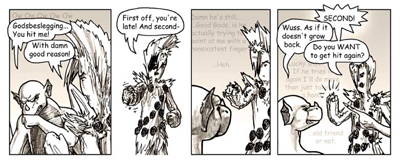 From there… well, quite a lot both happens and doesn’t happen. The artist, Mari Rose, has created this fantastic cast of characters, and almost every one of them is having their own adventure. We get to see everything from the god of knowledge outclassing magic with simple smarts to the botanical version of Gumby squishing deformed mutant fish. The strip is filled with fantastic art, a good sense of humor and a compelling story. Well… several compelling stories, as it were, and that seems to be both a good thing and a bad thing. Right from the start, she’s beset by Robert Jordan syndrome, and that means the plot is going nowhere fast.
You may have heard of Robert Jordan – if not, he happens to write a little fantasy series called the Wheel of Time. It’s a powerful, compelling epic story that has thousands upon thousands of pages to its name… and is in danger of never coming to an end.
You see, Robert Jordan wrote a world filled with interesting characters… and found himself paying equal weight to each and every one of them. Early on, events proceeded without difficulty, but as more and more characters appeared, and each went on their own way… time slowed to a crawl. In one of the more recent books in the series, the entire book essentially takes place over the course of a single day, with us being shown the events of that day for every one of his myriad heroes and villains.
I like most of those characters – but it impedes the story. Without a focus, there will never be progress. This has been one of the greatest concerns regarding the Wheel of Time – and one that The Wings of Change has been suffering from as well.
Let’s compare this strip with Dominic Deegan. The clearly have a similar setting, and both favor a crisp, clear art style. Even aside from those similarities, both comics have the same sense of purpose and the same balancing act between personal developments and epic, over-arching plot lines. Even, occasionally, the same flair for painful little puns.
These days, Dominic Deegan is one of the most well-known strips around. It has had dozens of story-lines and more than a handful of epic, world-changing arcs. The Wings of Change, meanwhile, remains a nice comic, but certainly not a mover and shaker in the webcomic world – and since the comic began, less than half a week of time has passed.
Dominic Deegan started almost a year after the Wings of Change.
The difference, of course, is in the update schedule. It may not be the only difference – but it is the biggest one. I’d easily say TWoC has just as strong a sense of story, art and characterization – but time moves along at a crawl. Updates come once a week, not once a day, and filler is an all-too-common occurance. This doesn’t make it a bad comic, of course, and the artist certainly doesn’t owe us more comics…
But still. You can see that sense of potential unfulfilled. You can see how much more this comic could be, and how far away that inevitable epic plot really is.
Fortunately, the artist saw that too. She recognized the difficulties that have cropped up in folowing so many different characters at once. She noted that more updates certainly wouldn’t hurt. And that’s step one – recognizing the issue. From there… well, that remains to be seen. Regardless of where it goes from here, I’m confident that the strip will at the least continue on as it currently is – an enjoyable look into a world filled with a diverse cast of unique and engaging characters.
And I’ve got a feeling it’s on its way to being so very much more than that.
Dissertation on Overly Verbose Vegetation
I’m a fan of Girls with Slingshots. (The comic by Danielle Corsetto, that is. Though the metaphorical concept is pretty groovy too.)
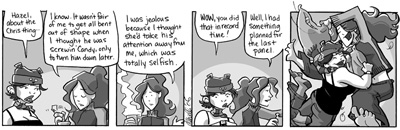 The comic has a lot of things going for it. The art isn’t just competent – it is alive, and dynamic, and doesn’t get the job done so much as bribe your mind into following it wherever it wants you to go. It’s a slice-of-life comic with a touch of magical realism, and manages to combine the two without feeling like a betrayal of the premise. The humor is certifiably witty. The characters all dauntingly unique. It even has a snazzy cast page and well-organized archive!
What I like best, though, isn’t any one of those elements. What gets me every time is simply how skillfully they are woven together. The specific element that has prompted today’s post is how well the strip handles transition.
Monday’s strip involved our protaganist Hazel detailing the consistency and jiggle factor of her “luscious” ass. Last Friday’s strip featured a heartfelt moment of love between two friends. The strip before that involved a shouting match between their talking pet cacti.
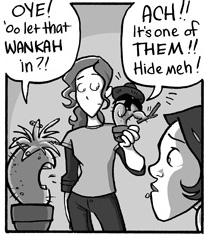 Today’s strip has Hazel confronting a past that has been hovering over her since the strip began.
Having both comedy and drama – sure, that’s all well and good. I like it – in many of my favorite strips, I practically expect it. But being able to move so smoothly between the two? Being able to hop between the two not just from one story-arc to the next, but one strip to the next? Between panels?
Damn, girl.
Maybe that’s what makes the strip feel so natural. Life doesn’t come into nicely compartmentalized little boxes for our convenience – it’s a jumble of everything all at once.
So yeah. Girls with Slingshots. Damn good comic. It’s down to earth, funny as hell and manages to capture all the little ups and downs of everyday life without ever taking itself too seriously.
A lot like life itself, I guess.
 Damn Good Comics