Everything’s Coming Up Zombies
 Seriously, everywhere I turn.
First off, The Stiff returned last week. One of the most genuinely spooky comics out there, it went on a sizable hiatus just as the story was really starting to get good. It appears to be back and fully in action with a weekly update, which is very good news indeed.
Continuing the zombie theme, they appear to currently be Dr. McNinja’s opponents of choice, which is usually as good a guage of the current internet craze as anything else. Also, he demonstrates the proper way for killing zombies – and by proper, I mean “most badass.”
Finally, I just discovered Last Blood, by Bobby Crosby and Owen Gieni, in which zombies have wiped out nearly the entire world, and vampires – in danger of losing their food source – desperately fight to keep the last remnants of humanity alive.
Come on, you can’t deny that is a great premise!
It’s well executed, too. As a matter of fact, I’ve been impressed with all of Bobby Crosby’s recent webcomic endeavors – not only are they good concepts and put together well, but there is an atmosphere of professionalism about them all. I should explain that my first encounter with Bobby was seeing him posting in one of the flame wars that were so prevalent in the webcomic community several years back – wherein he managed to make Scott Kurtz look like the most rational and even-tempered individual around. Bobby’s own comic at the time, Pupkin, wasn’t the most impressive strip out there.
I’d say he’s come a long way since then.
The Best of Drunk Duck: The Gods of Arr-Kelaan
I’ve been sent more than a few links to quality comics hosted on Comic Genesis, and I’ve spotted a few good ones in thi’s years Comic Genesis Free Comic Book – but it will take some time to truly soak them in. So while I let my thoughts on them simmer, it seemed a good idea to switch focus for a few weeks to some of my favorite strips from another hosting site – Drunk Duck, which has been working hard at overcoming its previous less-than-professional reputation.
I don’t have much experience with Drunk Duck in the past, so I can’t say much about the state it was previously in. These days the site design is functional, if somewhat cluttered, and it seems much easier to search through the various hosted comics than it was even a few months ago.
What I do know is that, while there certainly seems a plethora of more amateur work on the site, it also has some real winners.
 The Gods of Arr-Kelaan, by Chuck Rowles, is easily at the top of the list.
First, though, let’s talk about Dungeons and Dragons. One of many roleplaying games, D&D is often thought of as the king of the Hack and Slash genre – it is about looting monsters, levelling up, and fast-forwarding past the roleplaying part itself. To be fair, there are plenty of games along those lines – and there are plenty of times when just rolling the dice and chopping off an orc’s head is simply great mindless fun.
Even in more serious games with a much more dynamic plot, the thrill of combat has its place. But for all its focus on it, D&D certainly has the capability to be a game that indulges in story and depth. Regardless of the system at hand, that decision is one that comes down to the players – and to whomever is running the game.
I like running games. I am preparing to start one back up after several years on the sidelines, and I am remembering what is possibly my favorite part of the entire process – designing the setting. Developing an entire world, from creation myth to societal trends, from the rise and fall of past civilizations to the current dungeons and plot threads of the modern day.
I tend to think big, in terms of such things. It is both a strength and a weakness in many ways, and one felt just as much in my writing as in my games. It has one other added benefit – The Gods of Arr-Kelaan is able to win me over on the premise alone.
The main focus of the story is on a group of deities of Arr-Kelaan – ones who were, not all that long ago, ordinary people from Earth. Through mysterious circumstances, they end up on this strange new world with incredible powers, and find themselves settling into specific roles that fit their various personalities. Conflicts arise between them – and between other gods as well, including familiar deities from Norse, Greek, and Incan pantheons, all of whom have also found themselves on Arr-Kelaan.
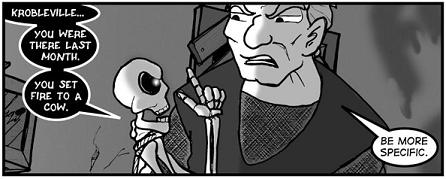 One would think that such dealings would result in epic storylines, as vast and incomprehensible powers are thrown about – and that does happen from time to time, sure. But the real focus of the series is on the humanity of the gods and their worshippers. Exploring how mortals deal with ascending to divinity, how they interpret their power and responsibilities in different ways, and the goals and motivations that drive them.
The story starts with the star of the show, Ronson, waking up in this strange new land and slowly discovering the powers at his fingertips. Unfortunately the rest of that part of the story isn’t online (though it is available in print.)
From there, we leave Ronson for a bit, as we get a look at some of the heroes of the land – with a number of shorter tales mixed in, introducing us to the various gods that have started to populate the land. While not central to the main plot that begins to develop (and, in fact, set a significant amount of time in the future of the main plot), these stories do a great job of fleshing out the characters and the setting.
And after that… well, that’s when we get into the meat of the story, as we see Ronson learning to accept his new-found divinity, even as he searches for a way home. We learn how even gods can be haunted by the ghosts of the past – and the puzzle of how he and his brethren ended up on Arr-Kelaan all begins to come together.

The story is not just about him, of course. There is a whole slew of gods and followers and even the occasional oracle. Seeing them all interact – seeing them change, and seeing the changes they leave across the world – is a very interesting thing, indeed. It makes for a good story, certainly – and leaves plenty of room for humor, of course. Don’t let the epic nature of what is going on make you think otherwise – seeing these ordinary people given control over life and death is a recipe for all sorts of hijinks, and Rowles easily keeps the tone light and fun.
But even while he does so, there is a bigger story building up. The creation of a pantheon. That is a big deal, make no mistake – and lately, the stakes have been only getting higher. Ronson’s quest for the ghost of his wife – which has been his greatest focus since the series began – has finally yielded fruit… and a much more dangerous enemy than imaginable.
And from there… well, I suppose you’ll just have to find out for yourself.
Memes and Manuscripts
Alright, this has gone too far.
…ok, I found the last one amusing. No, not the robots – sorry, Stevens & Jacques.
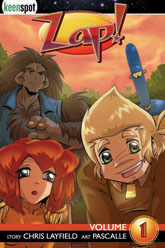 Outside of the strange world of the internet, I’ve been digging into my print copy of Zap! While my collection of webcomic books is not as vast as some, it is beginning to grow – I’ve got the Order of the Stick books on their way, and am looking forward to hunting down Birds are Weird when I can find it in stores. (Because, among other things, it is really, really cool to see webcomic books on the shelves, stocked as naturally as anything else.)
Reading through Zap! Volume One has reminded me of the benefits of collecting the books, rather than just reading them on the web – a chance to go back through and refresh oneself on backstory, for one thing. Archives are getting easier to use, but few can offer the same ease as being able to flip between dozens of pages at the drop of a hat.
Some webcomics translate to printed form better than others, of course, and I really don’t have the funds or interest to go and buy every single one released. Then again, that just means I can really enjoy the ones I do get – when Zap! arrived in the mail, it outright made my day.
Which is as good an argument for putting webcomics in print as anything else I could think of.
I always seem to be precisely three months behind the times
 Clearly my promise of a post yesterday was a damn dirty lie. I have no regrets.
Well… aside from not learning sooner that PS238 started updating as a webcomic.
I’ve always enjoyed the works of Aaron Williams – I’ve had a subscription to Dragon Magazine for over a decade, and truth be told, I only really get it for the comics, and Nodwick was right up there with Phil and Dixie as my favorite features. While I’m sad that the magazine is getting the axe (especially since these days it features exclusive strips from Order of the Stick), the blow was softened by how accessible most of those self-same comics are online.
I’ve strayed from the point of this post, however: PS238, one of my favorite print comics out there. Now being posted online! That is certifiably kick-ass news.
DC and Marvel’s superhero comics have come under a bit of criticism in recent years – much of it deserved. Their stories are generally punctuated with unnecessary death at every turn, and rather than being tales of triumph, are tales of defeat. They have some good titles among them, but many of their comics seem to have lost touch with what being a hero is all about.
PS238, on the other hand, gets it right. It is the story of Public School 238, a training facility for metapowered children. It manages to both indulge in cliché supervillains and supervillainry while also exploring dynamic and interesting story-arcs. The characters are all likeable, and unique even when clear parodies of existing heroes. The story is almost always lighthearded and fun, but that doesn’t stop it from having serious moments, thought-provoking storylines, and a great deal of underlying plot slowly building in the background.
And now you can start reading it for free. It doesn’t matter much to me directly – it is one of the few print comics I make sure to collect. But I like the fact it is now out there on the web to lure people in. It worked for Girl Genius, and I bet it will work for this.
So go ahead, check it out, and be assured that there is hope for superhero comics yet.
A Few Quick Notes
I’ll be back in business with regular posts starting tomorrow, but for now, a few quick notes:
–Sam and Fuzzy turns 5, and is going stronger than ever. A tip of the hat to Mr. Logan!
-I just discovered the return of Abby’s Agency, an enjoyable little strip about an ordinary girl who gets a job as a secretary with a secret government spy agency. It went on a mysterious hiatus some time ago, and I only just noticed it had returned this last month – so that’s a plus.
-I also was informed that Niego had returned, a crazy little strip that sprung up in recent years, burned brightly, and then went out with a bang. And then, apparently came back! Only maybe not – I notice that it hasn’t updated in a month and a half, which bodes poorly. The latest news post mentions the artist going out of town for a bit – here’s hoping the strip’s downtime has been due to entirely mundane and boring life troubles, rather than, say, a zombie attack.
-In other news, Brian Daniel (of Surviving Mars) is looking at shifting gears with his comic – once the current arc wraps up, he’s looking at putting it into a temporary hiatus, and henceforth release it in one full story-arc at a time. Honestly, it isn’t a bad idea – one of his previous series, the Saga of the Ram, ended eruptly right while it was heating up, and I wouldn’t want to see Surviving Mars do the same. Moving from a standard update schedule to an issue-driven routine is a tricky one, but it’s been done before, and if it helps the artist enjoy making the comic, then I’m all for it.
-I’ve found Penny Arcade surprisingly sub-par the last few weeks – but I’ll assume that’s due to their attention being focused elsewhere. I mean, damn, have you seen the trailer for On The Rain-Slick Precipice of Darkness? If not, go here, scroll down a bit. I am completely blown away by this.
I talked about this before – others have tried to branch out webcomics into new and exciting grounds, such as with the PvP and Ctrl+Alt+Del animated series… and sure, those weren’t bad. But you could feel that they were new, and they were experimenting with how to capture the feel of the strip in this new format, and were learning as they went. Even with both of those strips being big names in webcomics – even with them working with a studio intent on releasing kick-ass animation.
But Penny Arcade has the name and the resources and the flair to make their own experiment work. It feels professional. It doesn’t feel like little kids playing with some new toys – it feels like them taking their carefully crafted product and translating it into a new format, smoothly and successfully.
Of course, we won’t know for sure until the game itself comes out, but a trailer like that is an awfully promising sight.
A Notice, Because I Can’t Not Mention It
Issue 3 of Cheshire Crossing is out… and somehow, someway, Andy Weir has managed to top the first two.
I liked Casey and Andy. It was a really good comic – and I hope to see it complete one day.
But Cheshire Crossing is just filled with so much unbridled awesomeness that it easily takes the cake. If this is where Meir wants to focus his efforts, he’ll get no complaints from me. The release schedule – a new issue every 6 or so months – is an unusual one, but I’ve found that rather than leaving me frustrated with anticipation for the next comic, every new issue instead comes as a wonderful sort of surprise.
I’d ramble on about my favorite parts of the issue, but I’d rather have everyone go and experience them directly. So go! Check it out, spread the news, and enjoy.
A Very Good Question
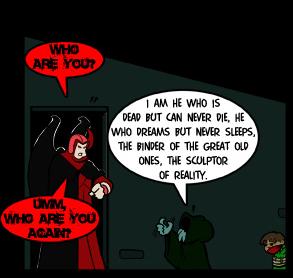 “Who are you?”
That… is a very good question indeed.
Other good ones: Why are you here? And what in the hell is going on?
The scene is Dungeon and Dorks, a fantasy webcomic parody of a certain famous roleplaying game. For a long while, I considered DnDorks to be among the top such comics, to have nailed its rendition of gamer humor as well as the best of them.
Then it lost me. Not in the sense that I no longer enjoyed the strip – no, it lost me in that all understanding of plot went right out the window.
The figures to our left are Venger, an apparently recurring villain, and Mac’thulu, who is as he says he is.
I’m not entirely sure where either of them came from. I’m not sure why the story is focusing on them, nor what has happened to the main characters, or the side characters, or the NPCs, or any of it. I suspect a full read through the archives would clear some things up, if not all… but this is also a comic I started reading within the last two years. The archives aren’t really all that far from memory.
Let’s begin with a basic description of the strip. DnDorks is about a bunch of gamers, and at the same time, it is about the characters in the game they play. These stories are told essentially hand in hand, often to good effect. Over the first four or five years of the strip, it combined clever jokes about these few iconic gamers, while also developing them as interesting individuals with lives of their own.
A little over a year ago is when the confusion started to arise. The main cast of gamers was set aside for DnDorks – the Next Generation! This featured younger siblings of the main crew trying their own hand at DnD for the very first time – which, on its own, is a perfectly cool idea. A chance for adding some new blood to the strip, walking down some similar paths and some new ones, and setting things up for an all around good story arc.
It was a little confusing for me, mainly due to the transition – the new characters basically showed up, with little explanation of who they were. I gather, looking at the cast page, they may have shown up previously as filler – but for me, they were all new and out of the blue.
But hey – that alone wasn’t too big a deal. The new cast was well-rounded and enjoyable to see in action. Once the initial shock of the shift was over, it made for a good read.
Then they decided to start remaking the earliest strips in the archives, updating them with art consistent with the new format. Not a problem in and of itself – in fact, a damn good idea. Except… they posted the new old strips like regular updates. If you knew what was going on, it was possible to keep the stories separate – but it also meant you had to actively be paying attention to do so. Each update, you had to mentally file the page in a different place.
It wasn’t much – but it muddied the waters enough that when the real confusion hit, it made things oh so much worse.
The latest storyarc has involved, as far as I can tell, a blurring of the lines between the gamers themselves and the characters they play. Through strange machinations, the “next generation” has been brought into their game world by this villain, Venger – and in order to stop whatever evil scheme this is a part of, the original cast was brought into the game world by this other fellow, Mac’thulu.
So – hey, I can describe the general story that is going on, so that means the comic hasn’t descended into complete gibberish. The problem is that the general understanding is as far as it goes – I haven’t been able to follow any given strip, or precisely how all this has come to pass, or the motivations behind anyone or anything.
The core of the problem is that we have a crossover between both the new generation of gamers and the old generation of gamers and the characters both teams play – while in the background, classic strips from the archives are running in-between. With new and important villains coming out of left field. With dramatic reveals at every turn. With an art style that is very nice to look at, but also includes a layout that tends to jump past important bits of the action – usually relying upon narrative to fill us in on the blanks, which works a whole lot better when the reader remembers where the characters are and what they are doing.
Therein lies the problem – any single one of those elements wouldn’t be enough to leave the reader bewildered. But all of them together…
And it’s a shame, because I like all these characters. I like the idea of having characters sucked into their game world, I like seeing the new dynamic of the younger crew matched against the familiar stasis of the old, I like the fact we have a miniature Old One named Mac’thulu. It’s all clever and fun, but I realized the other day that I had spent the last year reading the strip without being able to even name most of the characters anymore.
That’s not good, people. The more confused I got, the more frustrating the story was, because I didn’t have the time each week to go digging through the archives to try and set each new thread straight – especially with the classic strips still popping up out of order, even in the archives. I wasn’t losing the strip because of the characters or the story or the jokes, but because of simple poor organization.
It doesn’t mean I’m going to stop reading the comic, unless it continues to pile layers of convolution on at every turn. Right now, it looks like the current story is getting close to the big ending – which I am desperate for. Because until then, every update just means I glance at the page, shake my head, and wait for things to make sense again.
And if that is the response that a storyline that could be wildly entertaining is having on your readers, it’s time to ask yourself why it is happening – and what you can do to fix it.
Remembrance
As a child, I read and reread The Chronicles of Pyrdain a countless times over.
This five-volume series is by Lloyd Alexander, who passed away last week at the age of 83. It was not surprising that I enjoyed the tales of a young boy who went from a simple kid to a hero and a king – not in the least because it wasn’t just a story of wish-fulfillment, but one of genuine growth and heroism.
I read them many times as a child – and even now, these stories are among the few that I still return to time and time again. Perhaps that is one of the defining marks of a truly good story – being able to inspire one to return, once again, to well-worn pages for yet another telling of the tale. That in spite of knowing what is coming – of knowing every little twist and reveal – every page is as enjoyable as the time before.
There are some stories out there that I’ve read several times more from necessity than desire, and these are not bad stories – the Wheel of Time is a good example of a story so overwhelmingly plot-filled that it requires a week playing catch-up every time a new volume comes out. There are more than a handful of webcomics that are similar in nature – that every so often require another trip through the archives just to know what is going on.
But there are also those precious few that present a story so solid, so enjoyable, so timeless, that I return to them again of my own volition, compelled by nothing more than memory.
The Chronicles of Prydain were among the first such stories to have stayed with me throughout the years. They will stay with me forever.
Rest in peace, Lloyd Alexander. You will be remembered.
Step One
I’m of the opinion that webcomic donations drive can be a crutch when too heavily relied upon – but also a valuable tool to kickstart a real career in comics.
I’m generally of the mind-set that I want most comics to succeed. Note in the least because webcomics – and the people that make them – seem a lot more personal than most forms of media, but also because more success means I can enjoy them better too.
From what I’ve seen it takes a bit more than just letting the money come to you – it takes planning out an effective strategy that lets you make money off of what is, essentially, a free product. Tycho’s manifesto said that if you trust in your readers, they will take care of you – and this is true, so long as you are able to find the right means for them to do so.
But finding those means requires careful thought and preparations, and it is hard to do that while also producing several pages a week, plus working an actual job to stay alive in the meantime. And cutting back the comics themselves in order to find them time to figure out how to make them profitable is an iffy proposition – you just might lose your readership while in the midst of figuring out your master plan.
Hence – the donation drive. It isn’t something to rely on for a lifetime of survival, but it can give you that boost to start things off. Come into it with reasonable expectations, and take whatever success it gives you as victory – and the seeds to truly start something larger.
I mention this because of one such drive that has just started, by T Campbell and Gisèle Lagacé, the minds behind Penny and Aggie.
Neither of these folks are new to the webcomic world. They’ve been doing comics as long as most of the success stories, and have put out some of the most impressive works on the net. Penny and Aggie has held my attention since its appearance, and I suspect will do so for quite some time.
More than that, they are offering some impressive incentives with their drive – gift cards, artwork, songs, along with a conclusion to Gisèle’s former work, Cool Cat Studio, and a new Fans story – and all of that is for not even reaching their primary goal, which would allow Gisèle to quit and work on the comic full-time.
So… if you feel like donating to webcomics, this is a damn good cause. If you especially like Penny and Aggie, or the creators behind it, this is a great opportunity to reward them for their efforts.
And even if you aren’t able to drop a dollar for them – and no one holds it against you if you can’t – it doesn’t cost anything just to post a mention of the drive, and spread the news far and wide.
Here’s the link: Dear readers…
The Best of Comic Genesis: The Prime of Ambition
 The Prime of Ambition is a fantasy comic, which is usually a sign that a strip will be walking down a well-worn path that many have trod before, telling the same stories that have been told countless times before. This would not be a bad thing, for those stories are still good stories after all these years – but that is not what Ambition is about.
The Prime of Ambition is about telling a new story.
The Prime of Ambition is about defying expectations.
Our story begins with four young heroes on the brink of battle. They have come upon a dastardly sight – several soldiers of a corrupt nation are sacrificing an innocent maiden to a dragon. They know it will not be an easy fight, but they cannot simply stand and watch. With faith in the righteousness of their cause and their god, they charge into battle.
In a single panel they are slaughtered by a half-dozen unnamed soldiers.
They are not the heroes of the story. The two of them that survive are taken captive, and they serve one purpose – as a vehicle to open the story, and begin a tale that I expect will have many unexpected twists along the way.
Ambition, despite having its own story to tell, manages to stay strong on one of the greatest assets of the fantasy story – the setting. Not just its nature, but the fact that one has an entire world to play in and develop, a world of different races and cultures and societies, different lands and different rules. Ambition is set in the world of Oris, and one is able to get a sense for the detail of the setting from every distinct individual and place. The site also includes a guide to the world as well, so one can see it fleshed out outside of the story itself – which is a good thing, as attention to detail carries with it one fatal flaw, the deadly beast known as exposition.
The story is narrated by an elf named Audriel Sillendrey, a figure whose world-view has clearly been changed by the story he is about to tell us. First person narration isn’t a bad format, and is able to give us some insight into his character while leaving the mystery of other characters open. Unfortunately it also means he spends a lot of time – especially early on – explaining and introducing.
It is a necessary evil, in the end, and one made more tolerable by the art that accompanies it – each page is full color and filled with detail, bringing the world to life with every panel. In some ways it is a shame when such gorgeous artwork is cluttered up with text – but like I said, necessary evil. You can’t tell a story without setting the scene, and if the artwork is engaging when in the midst of exposition, it promises to be mind-blowing once the action gets going.
There are less than 60 pages in the archives, and the strip updates once a week, so perhaps its greatest downside is a tendency towards a slower pace – especially given the early part of the story is focused on character development over action. Whether that is good or bad, of course, depends on the characters, and – fortunately for us – that is where Ambition really shines.
As mentioned earlier, the story is told by Audriel, a sun elf – but he is not the star of the show. There are a couple other characters of note, but the main focus of the story is a drow named Thanatos. And Than… well, Than is somewhat complicated to explain.
The narrator, Audriel, hates him – hates all drow passionately due to his own personal tragedy, in fact. So we have to balance his view – that all drow are evil – with Than’s own actions, which tend to present him as a tragic figure trying to make amends for his people.
Now, if that was it, then this would be just another story told many times before. He wouldn’t be just another Drizzt, sure – no dual scimitars, no magic cat figurine, and the people he comes from are an entirely different type of drow; but it would still be falling into the stereotype of the outcast who has to prove himself against a society that distrusts him. Which wouldn’t make it a bad story, but it also wouldn’t be anything new, just the same tension seen – and overcome – countless times in the past.
But as far as I can tell, Ambition takes it a step further – because I get the sense that Than’s kind nature and behavior is all just an act.
I could be wrong. I suspect there is a lot more to it than any simple explanation might give – but there have been enough subtle clues that this apparently kind drow is fully manipulating those around him. That he has an agenda and motives well beyond what has been revealed thus far, and that learning more about that – and about him – is when the story will really start to get moving. He may not be evil, but the way he seems to act and move and speak strike me as those of a character who may well be amoral – who acts according to their own views, not through limits set upon them by society. And that makes for an interesting character indeed.
Of course… this is just my interpretation of the story and the character. Ambition is only in the second chapter, and it could easily have been an overly hasty judgement. As I said – I could be wrong. Who knows where the story could go from here?
But having those questions, and finding out the answers, is the mark of a good comic. Engaging that interest and curiosity is the sign of a good story. And as to whether my theories turn out right or wrong in the end… wouldn’t it be best to go and find out for yourself?
 Damn Good Comics